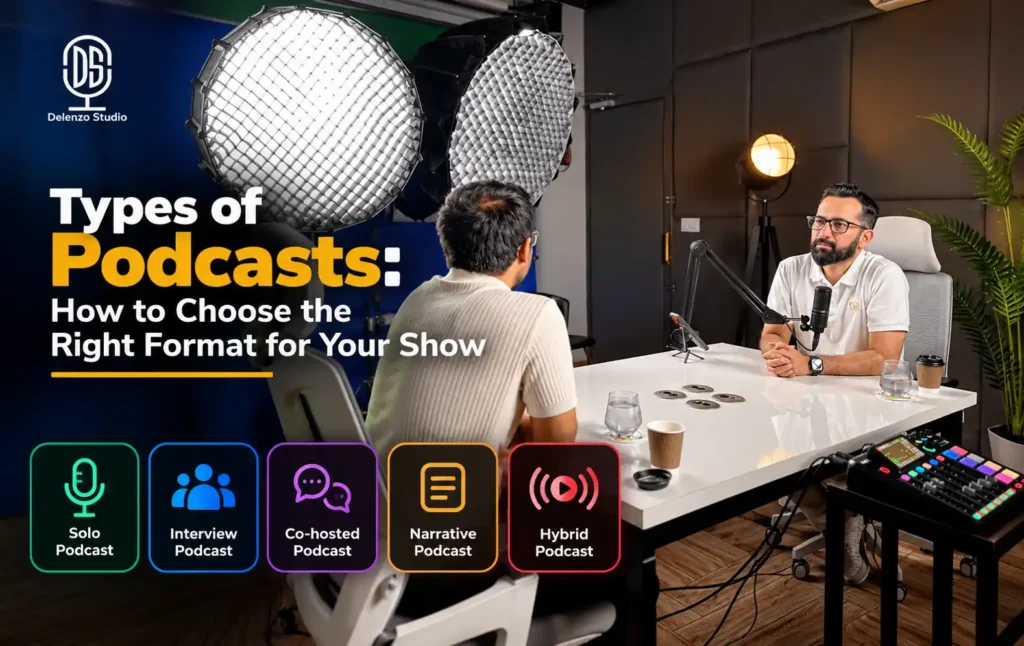
The most common types of podcasts are solo, interview, co-hosted, panel or roundtable, and narrative storytelling shows. Each one structures an episode differently, with its own number of voices and workload.
These five are not the only options. Many shows mix formats, like weekly solo episodes with a monthly guest, or switch styles between seasons. If you are new to the medium, start with our guide on what a podcast is and how it works.
The right fit depends on:
- Your topic and how much it relies on outside voices
- Your hosting style and comfort on a mic
- How easily you can book guests
- Production complexity and editing workload
- Whether you will publish audio-only or video
This guide breaks down the main podcast formats, who each suits, and what it takes to record them well. Our team sets up mics, cameras and lighting for podcast sessions at our Lahore studio, so this advice comes from real recording experience.
What Are the Main Types of Podcasts?
Quick answer: The five core types of podcasts are solo, interview, co-hosted, panel/roundtable and narrative storytelling. They differ by how many people speak, how the episode is structured, and how much production work each needs.
A common mix-up is treating format and genre as the same thing. They are not.
- Format is how an episode is built. It covers who talks, how many people join, and whether the content is scripted or conversational.
- Genre is the topic. Business, comedy, true crime, education and tech are all genres.
A true crime show can be narrative or co-hosted. A business show can be solo or interview-based. Once you separate the two, choosing between podcast types gets much simpler. You pick your genre based on what you know, then pick a format based on how you want to deliver it. As the Wikipedia entry on podcasts notes, the medium covers a huge range of styles, from solo commentary to fully produced audio drama.
Here is how the types of podcast formats compare at a glance:
| Format | Best for | People involved |
|---|---|---|
| Solo | Experts, educators, personal brands | 1 host |
| Interview | Guest expertise, founder stories | Host + guest |
| Co-hosted | Recurring chemistry and discussion | 2 regular hosts |
| Panel / roundtable | Multiple viewpoints, brand discussions | 3+ speakers |
| Narrative | Documentary and scripted stories | Narrator + contributors |
The table also works as a quick podcast format by guest count guide. Solo needs one voice. Interview and co-hosted shows need two. Panels start at three, and every extra person adds a mic, a track and usually a camera.
Solo Podcast Format
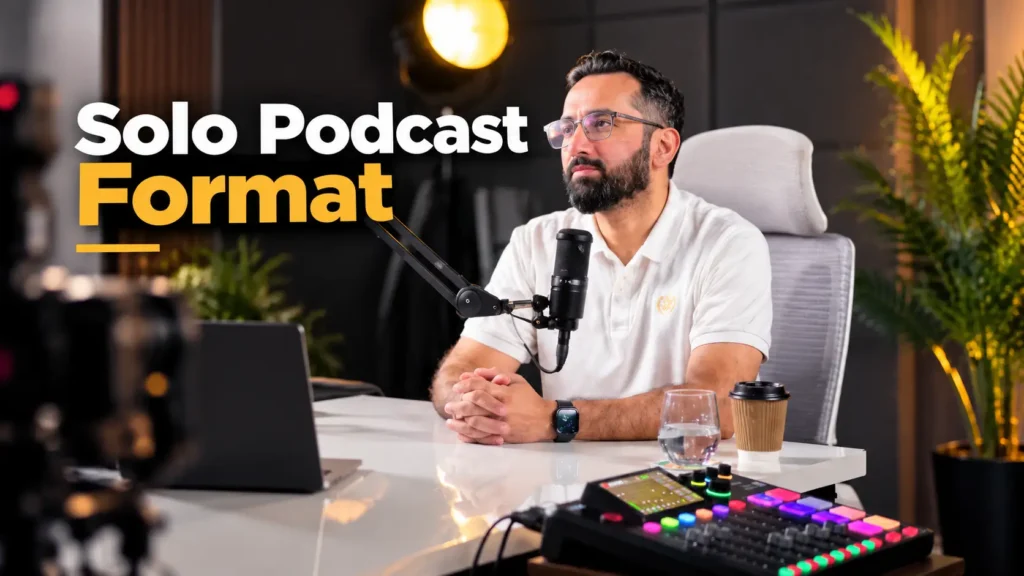
A solo show has one host and no guest. You speak straight to the listener, the way a teacher talks to a class or a coach talks to a client.
This setup works well for:
- Experts teaching a framework or method
- Commentary on news in a specific industry
- Educational series, like a 10-part course in audio form
- Personal brands built around one person’s ideas
The biggest advantage is control. You record when you are ready, with no one else’s calendar to match. Listeners hear one consistent voice, which builds familiarity over time. There are no guest reminders, no last-minute cancellations and no reschedules. Editing is usually lighter too, since there is only one track to clean.
The trade-off is real, though. You carry the pacing and energy alone. Nobody jumps in when you lose your thread or slow down. A loose outline with three to five main points helps a lot. Many solo hosts also keep episodes in the 15 to 30 minute range, which makes energy easier to hold.
On the gear side, a solo podcast setup stays simple. One mic, a pair of closed-back headphones and a quiet room cover the basics. A dynamic mic picks up less room echo than a condenser in untreated spaces. For specific models and budgets, see our podcast equipment list for Pakistan instead of buying blind.
Choose solo if you can speak confidently on your topic for 20 minutes without a guest prompting you.
Interview Podcast Format
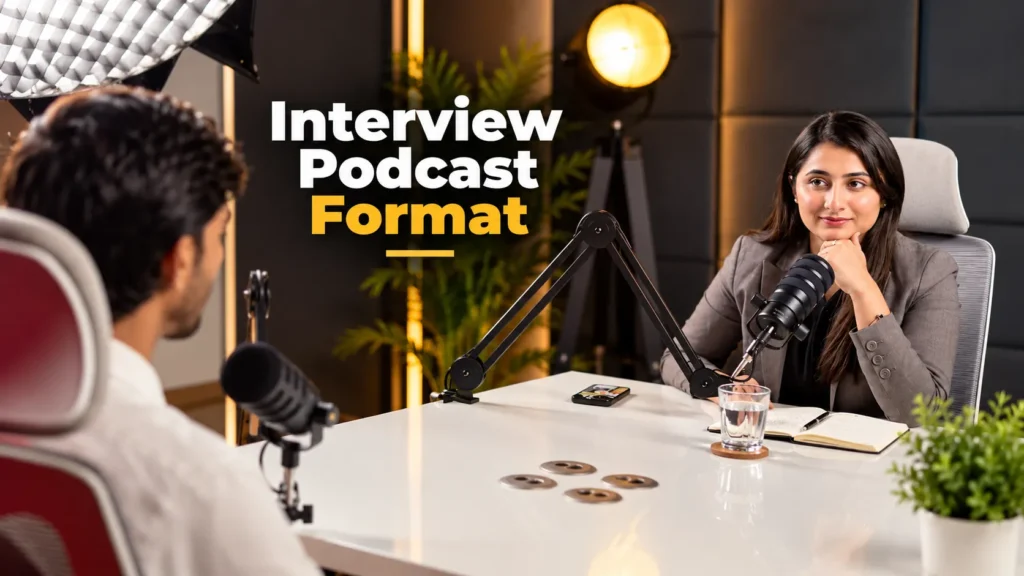
An interview show pairs a host with a guest. The host steers the conversation, and the guest brings the expertise, the story or the fresh angle.
Popular use cases include:
- Expert interviews on a niche topic
- Customer stories for a business or agency
- Founder conversations about building a company
- Thought leadership content for B2B brands
This format needs more preparation than solo. Here is what a clean interview podcast recording requires:
- One mic per person. Sharing a mic makes one voice louder and the other distant.
- Separate tracks where possible. An audio interface with enough inputs lets you fix each voice alone if someone coughs or talks over the other.
- Guest preparation. Send the topic, rough questions and expected length a few days ahead.
- Mic distance coaching. In our studio, the most common sound problem with new guests is sitting too far from the mic.
- Optional video. Two cameras give each person a clean angle. A third wide shot adds variety for clips.
The operational trade-off is simple to describe. Guests bring variety and reach, since many share the episode with their own followers. In return, you take on scheduling, follow-ups and guest management every single week.
That is why the solo vs interview podcast decision often comes down to consistency versus growth. Solo is easier to keep on schedule. Interviews tend to bring new listeners faster, because each guest opens a door to a new audience.
For creators without a two-person room, Delenzo Studio’s two-mic podcast setup is ready for host and guest, with mics, cameras and lighting already in place.
Co-Hosted Podcast Format
A co-hosted show has two regular hosts on every episode. That is the key difference from an interview show. In an interview, the guest changes each week. With co-hosts, the same pair returns every time, and listeners come back for that relationship.
The co-hosted podcast format suits topics where back-and-forth adds value:
- Commentary on sports, tech, film or industry news
- Education where two hosts explain things from different angles
- Entertainment shows built on humor and banter
- Business discussion between partners or colleagues
Chemistry drives this format, but consistency keeps it alive. A few habits make a big difference:
- A recurring schedule. Pick a recording slot both hosts can protect every week.
- Equal mic treatment. Use the same mic model, the same distance and matched levels. Otherwise one host sounds louder or further away.
- Defined roles. One host can lead and keep time while the other adds research, jokes or counterpoints.
- A repeatable structure. For example: quick intro, main topic, a recurring segment, then a wrap-up.
Choose co-hosted if you have a partner who shows up reliably and your conversations already feel worth listening to.
Panel or Roundtable Podcast Format
A panel show brings three or more speakers into one conversation, usually with a host acting as moderator. It works much like a panel discussion at a conference, where several experts react to the same question from different angles.
The panel podcast format works well for industry debates, roundtables and branded discussions. It also demands the most gear and coordination of the conversational formats:
- A mic and a separate track for every speaker
- A multi-guest podcast setup with enough inputs and headphone feeds
- Clear moderation, so voices do not overlap
- For video, a multi-camera setup with clear framing rules for multi-guest video
Choose a panel if multiple viewpoints make your topic better, and you can manage guest logistics and moderation.
Narrative Podcast Format
In the narrative podcast format, the story itself is the product. Research, scripting, narration and editing shape the whole listening experience. Think documentary series, investigative shows or scripted brand stories.
Editing often takes far longer than recording, because music, sound design and interview clips have to be woven into the script. That makes narrative the heaviest format to produce, so plan the time or budget for a post-production-heavy workflow before you start.
Choose narrative if the story matters more than the conversation, and you can commit to scripting and editing.
Audio Podcast vs Video Podcast
Audio versus video is not a separate format. Think of it as a delivery layer that sits on top of any format. A solo show can be audio-only. An interview can be filmed with three cameras. A panel can go either way.
An audio podcast keeps production lean. You need mics, headphones, a quiet room and an audio edit. That is about it.
A video podcast adds several moving parts:
- Cameras and careful framing for each speaker
- Lighting that flatters faces and stays even across angles
- A background or set that looks good on screen
- Sync between camera footage and audio tracks
- Extra editing for angle switches, color correction and captions
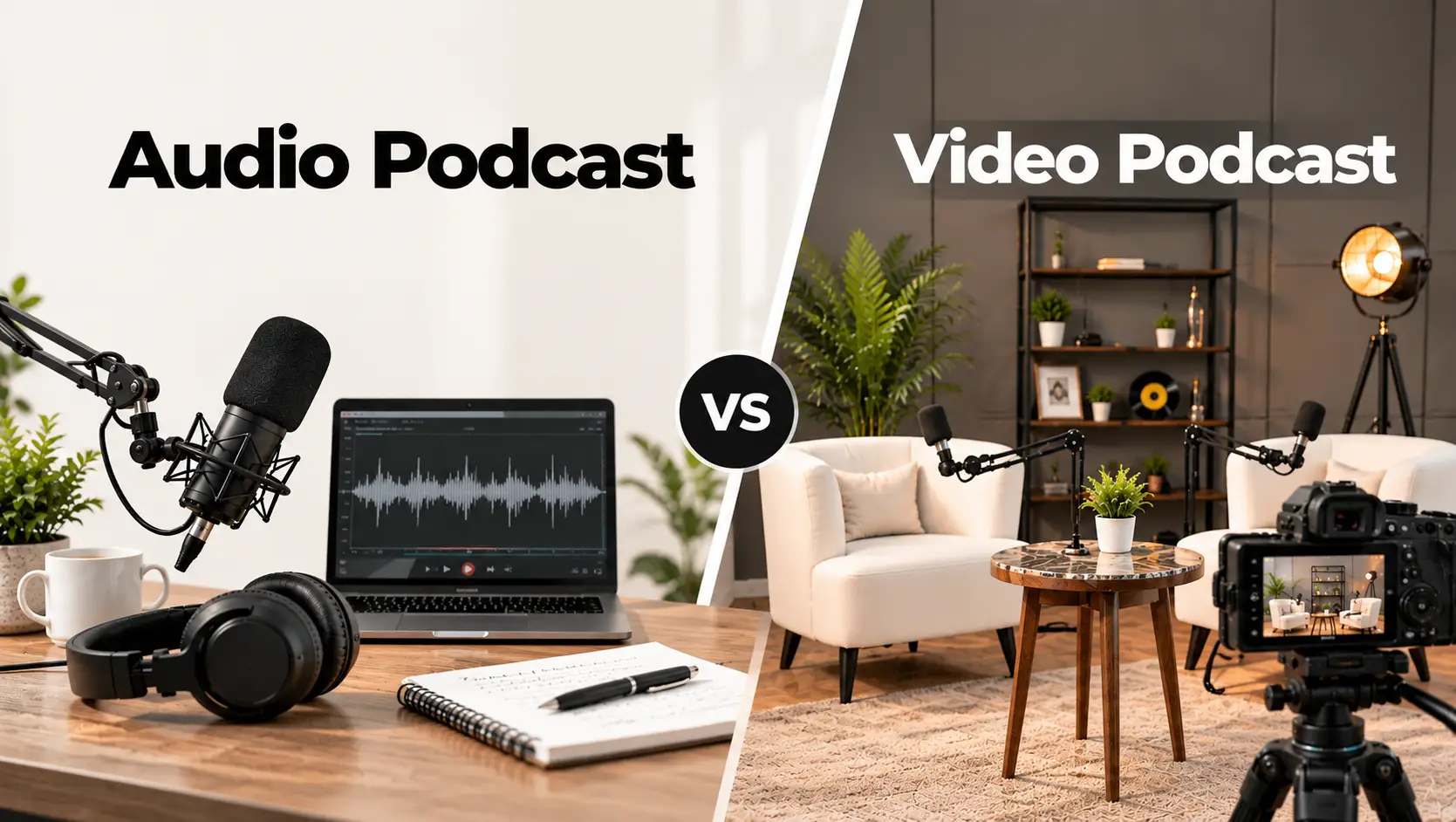
Lens choice matters more than most people expect. At our studio, we use a 50mm lens in the podcast camera setup. It gives natural head-and-shoulder framing without stretching faces like a wide lens can.
Hybrid production sits in the middle. You record video once, then publish in several places:
- The full episode on YouTube, which supports dedicated podcast playlists through YouTube Studio podcast features
- Audio on Spotify and Apple Podcasts
- Short clips for Reels, TikTok and YouTube Shorts
That approach works well for brands and creators who want reach on visual platforms. It is not always necessary, though. If most of your listeners tune in during commutes or workouts, audio-only may serve them just fine. Limited space at home does not rule out video either, since a small room video podcast setup can still look professional with the right layout.
Here is a quick audio vs video podcast summary:
| Format | Best for |
|---|---|
| Audio-only | Education, interviews, commuting listeners |
| Video podcast | Interviews, personal branding, YouTube, social clips |
| Hybrid | Brands and creators wanting both audio and visual distribution |
How to Choose the Right Podcast Format
Generic pros and cons lists rarely settle the decision. A short self-check works better. If you keep wondering which podcast format to choose, run through these points before booking any studio time:
- You can carry an episode alone. Solo becomes a strong option.
- You have steady access to guests. An interview show makes sense.
- You have a dependable partner. Co-hosting could be the natural fit.
- Your topic gains from several viewpoints. A panel adds depth.
- The story needs scripting and sound design. Narrative is the route.
- Visuals matter to your audience. Plan for video from day one.
Cost and effort also shape the choice. This table shows each podcast format by production complexity:
| Format | Production complexity | Editing load | Multi-camera for video |
|---|---|---|---|
| Solo | Low | Light | Optional |
| Interview | Medium | Moderate | Recommended (2 to 3 cameras) |
| Co-hosted | Medium | Moderate | Recommended (2 to 3 cameras) |
| Panel / roundtable | High | Heavy | Needed (3+ cameras) |
| Narrative | High to very high | Very heavy | Rarely central |
Budget planning gets easier once you know which formats need multi-camera recording. Interview, co-hosted and panel video shows usually do, since each speaker needs a clean angle. Solo video often works with one camera, plus an optional second angle for variety.
Knowing which formats require heavier editing matters just as much. Narrative shows sit at the top because of scripting, music and sound design. Panels come next, with several overlapping voices to balance. Solo shows are usually the lightest.
Choosing a Format for a Brand Podcast
For businesses, format selection follows the goal behind the show:
- Founder-led thought leadership often works best as a solo or interview show. Many companies record this through corporate podcast studio bookings.
- Industry credibility grows through panels with respected voices.
- Customer trust builds with interview episodes featuring real clients.
- Brand storytelling fits a narrative series, if the budget allows.
One more tip: you do not have to lock in forever. Test one format for a short season of six to eight episodes. Track downloads, watch time and listener feedback. Then check whether the workload feels sustainable. Many strong shows changed formats after their first season.
Record Your Chosen Podcast Format at Delenzo Studio
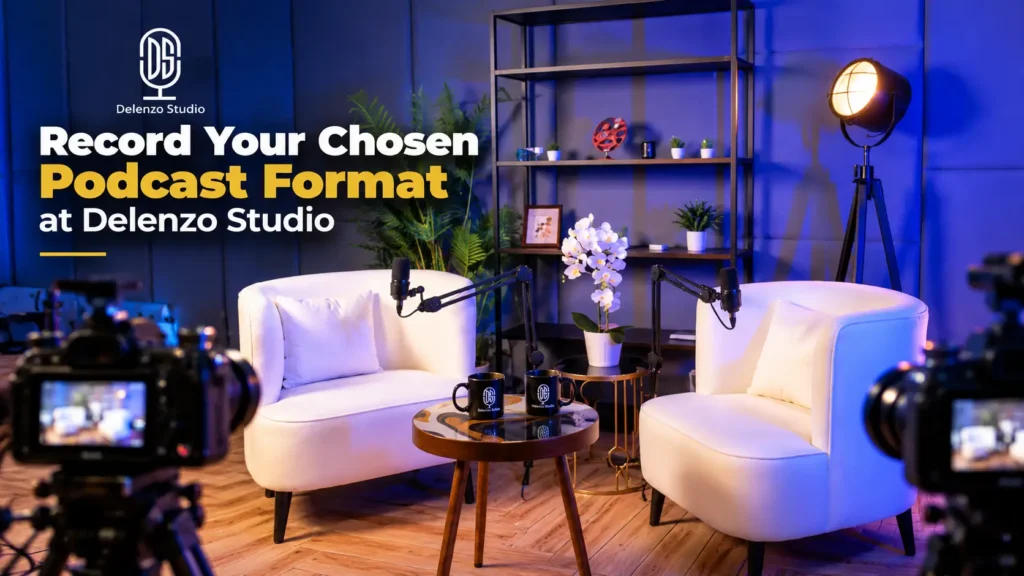
Many new shows struggle at the recording stage. Home setups rarely handle matched mics, multiple cameras or even lighting across several faces.
Delenzo Studio’s professional podcast studio in Lahore supports solo, two-person and multi-guest recording. Our team sets up the mics, cameras and Aputure lighting, so you can focus on the conversation.
Here is how each format fits our published podcast packages:
| Your format | Package | Starting price | Basic setup |
|---|---|---|---|
| Solo or narrative | Solo Podcast | PKR 15,000 | 1 camera, 1 mic |
| Interview or co-hosted | Two Persons | PKR 20,000 | 2 cameras, mic per person |
| Panel (3 speakers) | Three Persons | PKR 30,000 | 2 cameras, mic per person |
- Basic: one-hour session, raw files within one working day
- Plus: adds an edited episode, two reels, a teaser and a thumbnail
- Pro: adds a third reel, three thumbnails, a wireless mic and a teleprompter
Bigger panels can add extra cameras and mics as needed. Prices can change, so check the package page for current rates.
Chosen your format? Share your guest count, preferred format and whether you need audio-only or video production, and Delenzo Studio can help plan the right recording setup.
Picked your format? Record solo, interview, co-hosted or panel episodes in a ready-to-use studio with mics, cameras and lighting set up for you.
Explore Our Podcast StudioFrequently Asked Questions
The five main podcast formats are solo, interview, co-hosted, panel or roundtable, and narrative storytelling. Each differs by number of speakers, episode structure, and the production work involved.
A solo podcast is best for most beginners. It needs one mic, no guest scheduling, and lighter editing, so you can focus on building confidence and a steady publishing habit.
An interview podcast features a different guest each episode, while a co-hosted podcast has the same two hosts every time. Interviews bring variety; co-hosted shows rely on recurring chemistry.
Yes. A panel podcast needs a mic and track for every speaker, plus extra cameras for video. Moderation and editing also take noticeably more work.
Yes. Solo, interview, co-hosted, and panel shows all work well on video. Narrative podcasts can too, but they usually rely on audio storytelling, so visuals are optional.