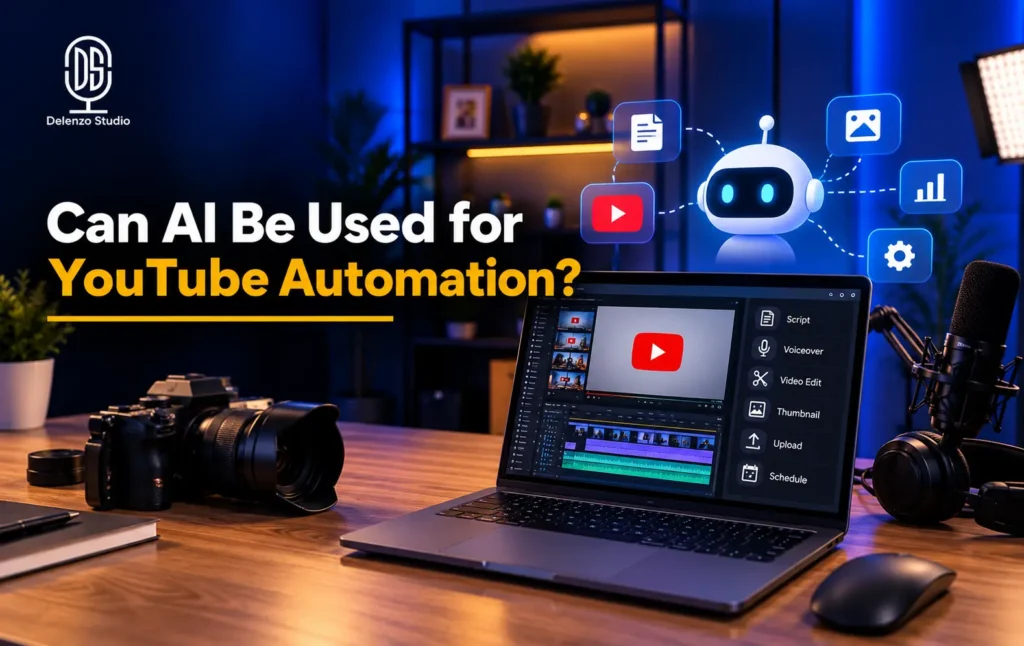
Yes, AI can be used for YouTube automation. In 2026 it can handle most of the work behind a channel: topic research, scripts, voiceovers, editing, thumbnails and scheduled uploads. What it still can’t do well is decide what your audience actually wants to watch, and YouTube’s monetization rules now penalise channels that let software make every one of those decisions.
That second part matters for Pakistani creators. Faceless and “automation” channels are among the most popular side-income ideas in the country right now, and YouTube spent 2025 and 2026 tightening its rules on mass-produced AI content. This guide walks through what AI can do at each stage, which YouTube rules apply, what changes for monetization in February 2027, and where a real voice or a real studio still makes the difference.
Check Your YouTube Monetization Eligibility
Is your channel eligible for monetization?
Enter your numbers from YouTube Studio → Earn. Compare today’s rules with the rules for new applicants from 1 February 2027.
Current rules (until 31 Jan 2027)
Enter your numbers above
New applicants from 1 Feb 2027
Enter your numbers above
Estimate only. YouTube also reviews your channel content, 2-Step Verification, strikes and AdSense before approval.
What Does YouTube Automation Mean When AI Is Involved?
The original idea of YouTube automation had nothing to do with AI. Channel owners hired freelance scriptwriters, voice artists and editors, then managed the output like a small production line. The owner rarely appeared on camera.
AI changed the cost of that model. Tasks that once needed three or four freelancers can now be drafted by software in minutes, so a single person in Lahore or Karachi can run a channel that would have needed a team two years ago. In practice most working channels sit somewhere in the middle:
- Fully automated: AI writes, voices, edits and uploads with almost no human review. This is the model YouTube is actively demonetizing.
- Semi-automated: AI drafts and assembles, a person directs topics, rewrites scripts, checks facts and approves every upload. Most channels that last use this approach.
If you are still choosing between a faceless format and appearing on camera, our faceless YouTube channel guide for Pakistan covers niche selection and setup in more detail.
Yes, AI can automate most of a YouTube channel in 2026, but it can’t replace human judgement.
- Topic research and scripts
- Voiceovers and captions
- Editing, Shorts and thumbnails
- Scheduling uploads
- Choose topics and fact-check
- Add your own angle or voice
- Tick the AI disclosure when required
- Review every upload
Heads-up: YouTube doubles Partner Program watch-hour requirements for new channels from 1 February 2027.
How AI Is Used Across the YouTube Pipeline
Here is a stage-by-stage view of where AI fits and where it doesn’t.
| Stage | What AI handles well | Common tools | What still needs a person |
|---|---|---|---|
| Niche and topic research | Brainstorming angles, clustering keywords, summarising competitor videos | ChatGPT, Gemini, Claude, vidIQ, TubeBuddy, Google Trends | Judging whether you can actually make 50+ good videos in that niche |
| Scriptwriting | First drafts, hooks, chapter outlines | ChatGPT, Claude, Gemini | Fact-checking, local examples, your own opinion |
| Voiceover | Clear English narration in seconds | ElevenLabs, other text-to-speech tools | Urdu pronunciation, emotion, pacing |
| Visuals and video | Stock footage matching, AI B-roll, avatars | InVideo AI, HeyGen, stock libraries | Picking visuals that match the point being made |
| Editing and Shorts | Auto-captions, silence removal, clipping long videos into Shorts | OpusClip, CapCut, Descript | Pacing, story flow, final cut |
| Thumbnails | Concepts, background removal, variations | Canva, AI image generators | Choosing the one that matches the title promise |
| SEO and publishing | Title and description drafts, tags, scheduling workflows | YouTube Studio, n8n, Make | Final title choice, disclosure settings, community replies |
Niche and Topic Research
AI chat tools are quick at generating topic lists, but they don’t know what Pakistani viewers searched last week. Pair them with real data: set Google Trends to Pakistan, check search suggestions inside YouTube itself, and use vidIQ or TubeBuddy for volume estimates. Our guide to YouTube SEO in Pakistan explains how to turn that research into titles that rank.
Scriptwriting
AI drafts are a starting point. They tend to repeat the same structure across videos, which is exactly the pattern YouTube’s systems look for when flagging repetitive content. They also get local details wrong: prices, tax rules, mobile packages, or anything that changed after the model’s training data. Rewrite the hook yourself, add one example only you would know, and check every number.
Voiceovers
English AI voices now sound close to human. Urdu and Punjabi voices have improved, but many still stress words oddly and stumble over names, which Pakistani viewers notice within seconds. Test a two-minute sample with a few people from your target audience before committing a whole channel to one voice.
Many creators end up using AI narration for drafts and timing, then recording the final voice themselves. If you go that route, a treated room makes a bigger difference than a new microphone. Delenzo’s voice-over studio in Lahore is set up for exactly this kind of batch recording.
Visuals and Video Production
Tools like InVideo AI turn a script into a rough video with stock footage, transitions and subtitles. HeyGen and similar platforms create a talking AI avatar. Both are useful for explainers and list videos. The catch: if the visuals are photorealistic and could be mistaken for real people or events, YouTube requires a disclosure (more on that below).
Editing and Short-Form Clipping
OpusClip and similar tools scan a long video and cut it into vertical Shorts with captions. CapCut and Descript handle auto-captions and filler-word removal. These are the safest AI uses on the list because they speed up work on content you already made. For cleaning up footage and audio, see our roundup of video enhancer tools for content creators.
Thumbnails and Branding
Image generators and Canva can produce dozens of thumbnail concepts quickly. Upload two or three versions using YouTube Studio’s Test & Compare feature and let real click data decide, rather than trusting the AI’s favourite.
SEO Metadata and Publishing
AI can draft titles, descriptions and chapters from your script. Scheduling inside YouTube Studio is enough for most channels, and it also protects you from load-shedding or internet outages on upload day. Larger setups connect tools such as n8n or Make to the YouTube Data API to move a finished file from a shared folder to a scheduled upload automatically. Whatever you automate, review titles before publishing; our list of common YouTube SEO mistakes Pakistani creators make shows what usually goes wrong.
Are You Allowed to Use AI on YouTube?
Yes. YouTube allows AI-generated and AI-assisted videos, but two sets of rules apply.
1. The synthetic content disclosure. When you upload, YouTube Studio asks whether the video contains altered or synthetic content. You must say yes when realistic AI visuals or audio could make viewers believe something real happened, for example a realistic person saying words they never said, a cloned voice of a real person, or fabricated footage of a real place or event. You don’t need to disclose:
- AI used only for scripts, captions, editing or thumbnail ideas
- Clearly animated, cartoon or obviously unrealistic visuals
- Beauty filters, colour correction and similar production effects
Through 2026 YouTube has also started applying the AI label itself when its systems detect undisclosed realistic AI content, so skipping the checkbox no longer hides anything.
2. Impersonation and privacy rules. Cloning a celebrity’s voice or face, or a private person’s, without permission can lead to removal under YouTube’s privacy and impersonation policies, separate from any monetization decision. Commercial use of a public figure’s likeness also needs their written permission.
Is There a “30% Rule” for AI on YouTube?
No. You may see this claim in videos and forums, but YouTube’s published policies contain no percentage limit on AI use. What YouTube reviews is whether the content is original, whether it adds value, and whether realistic synthetic elements are disclosed.
Can AI Videos Be Monetized on YouTube in 2026?
Yes, but this is where most automation channels fail. The relevant policy is inauthentic content. YouTube renamed its old “repetitious content” policy on 15 July 2025 to make clear it covers mass-produced and repetitive videos, and it widened enforcement again in July 2026 to include formulaic, template-driven content and AI personas discussing sensitive subjects like health and money. Industry trackers also reported a coordinated removal of mass-produced AI channels from the Partner Program in January 2026.
Videos that commonly get rejected:
- The same script reused with small swaps (city names, numbers, product names)
- Articles or Reddit posts read aloud by an AI voice over unrelated stock footage
- Slideshows of images with narration and no explanation or story
- Uploads where every intro, structure and thumbnail is near-identical
Videos that generally stay monetization-safe have a person choosing the angle and structure, add commentary, teaching or analysis, and feel distinct from one upload to the next even within a consistent format.
Can AI Voice Be Monetized?
An AI voiceover on its own doesn’t block monetization. YouTube reviews the channel as a whole. An AI voice delivering original research is treated very differently from an AI voice reading copied text. That said, a real human voice is one of the simplest signals of authenticity you can add, and it usually helps viewer retention too.
YouTube Partner Program Requirements: Now vs. February 2027
Pakistan is on the list of countries where the YouTube Partner Program is available. On 10 August 2026 YouTube announced new entry thresholds for new applicants, effective 1 February 2027.
| Requirement | Until 31 January 2027 | From 1 February 2027 (new applicants) |
|---|---|---|
| Subscribers | 1,000 | 1,000 |
| Long-form route | 4,000 valid public watch hours in 12 months | 8,000 valid public watch hours in 365 days |
| Shorts route | 10 million valid public Shorts views in 90 days | 20 million valid public Shorts views in 90 days |
Applications submitted before the deadline are reviewed under the current thresholds. Other requirements stay the same: 2-Step Verification on your Google account, no active Community Guidelines strikes, and a linked AdSense account. For Pakistani creators, the name on AdSense must match your bank account, and Google mails a verification PIN to your postal address before the first payment, so use an address where post actually reaches you.
Double the watch hours is a big deal for automation channels. Low-retention AI videos that might have scraped past 4,000 hours will take far longer to reach 8,000. Retention, not upload volume, is what gets a new channel monetized from 2027.
Is YouTube AI Automation Worth It in 2026?
It depends on what you mean by automation.
It is worth it if you use AI to cut production time while still choosing topics you understand, rewriting scripts in your own voice, and reviewing every upload. A solo creator can realistically publish more often and at a higher standard than before.
It usually isn’t worth it if the plan is “make $10,000 a month without making videos.” Most of those pitches come from people selling courses or tool affiliates. There are also costs that rarely make it into those videos. Most AI tools bill in US dollars, and earnings per 1,000 views for channels with mainly Pakistani viewers are usually much lower than for channels watched in the US or UK. Many Pakistani faceless channels target international, English-speaking audiences for this reason, which brings more competition with it.
A Practical AI Workflow for a Pakistani Faceless or Semi-Faceless Channel
- Pick a niche you can sustain. Use AI to list 50 video ideas. If you can’t add your own angle to at least 30 of them, choose another niche.
- Research with real data. Check YouTube search suggestions, Google Trends for your target country, and the top five videos for each topic.
- Draft with AI, rewrite by hand. Let AI produce the outline and first draft. Rewrite the first 30 seconds yourself and fact-check every claim.
- Decide on voice. Test AI narration against your own recording with a few viewers. Many creators batch-record a month of voiceovers in one studio session.
- Assemble and edit. Use AI tools for rough cuts and captions, then fix pacing manually.
- Clip Shorts from every long video. One long video can feed three to five Shorts, which helps discovery.
- Publish with the right settings. Schedule in YouTube Studio, set the synthetic content disclosure honestly, and reply to early comments yourself.
- Review analytics monthly. Drop formats with weak retention instead of producing more of them.
If you already run a podcast, recording it on video in a proper podcast studio gives you hours of original long-form footage that AI clipping tools can turn into Shorts. That raw material is authentic by default, which solves the biggest monetization problem automation channels face.
Where AI Falls Short, and Where a Studio Still Helps
The weak points of AI-only channels are fairly predictable: viewers drop off when narration sounds flat, comments call out “AI slop,” and nothing on the channel feels like it belongs to a real person. A small amount of real human presence fixes much of this.
Some practical ways to add it without giving up automation:
- Record a short on-camera intro or presenter segment once a month and reuse it across that month’s videos.
- Record final voiceovers in a treated room instead of relying fully on text-to-speech.
- Film original B-roll (product shots, hands-on demos, workspace clips) to replace generic stock footage.
Delenzo Studio in Gulberg, Lahore has a video studio and voice-over room that creators book for this kind of monthly batch session. Our studio packages for content creators explain the options, and the first-timer booking guide covers what to prepare. If you’d rather hand over the ongoing work, our YouTube channel management team handles uploads, optimisation and reporting.
How to Tell if a YouTube Channel Is AI-Generated
Viewers are getting better at spotting it, so it’s worth knowing what they look for:
- An “Altered or synthetic content” label in the description or on the player
- Narration with identical rhythm and tone in every video
- Stock footage that only loosely matches what’s being said
- Dozens of uploads with the same structure, posted daily
- No human replies in the comments
If several of these describe your own channel, that’s a sign to add more human input before YouTube’s review does it for you.
Final Thoughts
AI can run a large part of a YouTube channel in 2026, and Pakistani creators can use it to compete with much bigger teams. The channels that keep their monetization treat AI as a production assistant: a person picks the topics, shapes the script and stands behind every upload. With the Partner Program thresholds doubling for new channels in February 2027, retention and originality will count for more than upload volume.
If you want help building a channel on that semi-automated model, from scripts to studio recording to publishing, take a look at Delenzo Studio’s YouTube automation service or contact our team in Lahore to discuss your channel.
What AI does vs. what you do
1. Research
Tools: ChatGPT, Gemini, Claude, vidIQ, TubeBuddy, Google Trends
2. Script
Tools: ChatGPT, Claude, Gemini
3. Voiceover
Tools: ElevenLabs, other text-to-speech tools
4. Visuals
Tools: InVideo AI, HeyGen, stock libraries
5. Editing
Tools: OpusClip, CapCut, Descript
6. Thumbnail
Tools: Canva, AI image generators
7. Publishing
Tools: YouTube Studio, n8n, Make
Frequently Asked Questions
Can I automate my YouTube channel using AI?
Yes. AI tools can handle topic research, scripts, voiceovers, editing, thumbnails, metadata and scheduled uploads. A person still needs to choose topics, check facts and review each video before it goes live, because YouTube’s monetization rules reject channels that publish mass-produced content with no human input.
Are AI videos allowed on YouTube?
Yes, AI videos are allowed on YouTube. Creators must turn on the altered or synthetic content disclosure in YouTube Studio when a video contains realistic AI visuals or voices that viewers could mistake for real people, places or events. Clearly animated or unrealistic content, and AI used only for scripting or editing, does not need the label.
Can AI videos be monetized on YouTube?
Yes, AI videos can be monetized if they meet YouTube Partner Program policies. YouTube’s inauthentic content policy removes monetization from repetitive, templated or mass-produced videos, so each upload needs original value such as commentary, teaching or storytelling.
Can AI voice be monetized on YouTube in 2026?
Yes, a video with an AI voiceover can be monetized in 2026. YouTube has no rule against synthetic narration itself; it judges the whole channel. An AI voice reading copied text over stock clips is likely to be treated as inauthentic content, while an AI voice delivering an original, well-researched script usually is not.
Is there a 30% rule for AI on YouTube?
No. YouTube’s published policies do not set a 30% limit or any percentage limit on AI use. The rules that apply are the synthetic content disclosure requirement and the inauthentic content policy, which looks at whether a video is original and adds value.
Does YouTube pay $1 per 1,000 views?
No, YouTube has no fixed rate per 1,000 views. Earnings depend on the niche, the countries your viewers are in, ad demand and how many views are monetized. Channels with mostly Pakistani viewers usually earn less per 1,000 views than channels watched mainly in the US or UK.
Is YouTube automation worth it in 2026?
YouTube automation is worth it in 2026 for creators who use AI to speed up production but still add their own research, voice or presence. Fully hands-off channels built from templates carry a high risk of demonetization, and new channels will face higher Partner Program thresholds from 1 February 2027.