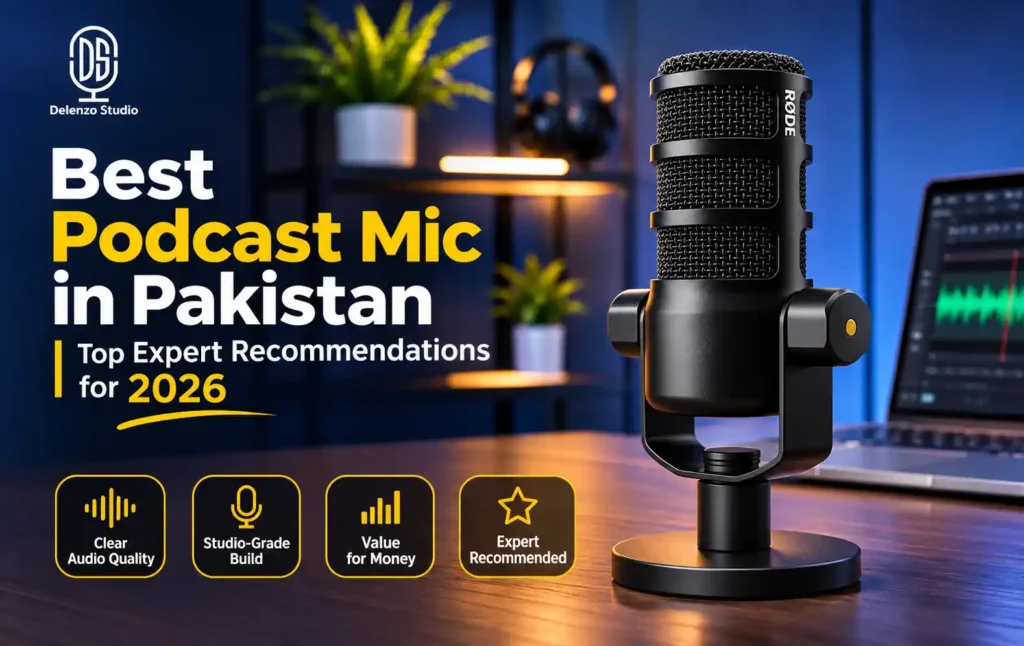
The best podcast mic in Pakistan is not automatically the most expensive microphone on the shelf. Your room, recording format, connection type and number of speakers matter just as much as the brand name.
For most Pakistani home podcasters recording in bedrooms, offices or untreated rooms, a good dynamic podcast microphone is usually the safer choice because it focuses more closely on the speaker and picks up less room sound. A condenser microphone can capture more detail, but it also reveals echo, ceiling fans, traffic and other background noise more easily. Delenzo Studio’s own podcast equipment list for Pakistan makes the same distinction when matching microphones to real recording environments.
Our top overall recommendation for a serious home or studio podcast is the Audio-Technica AT2040. For creators who want USB convenience with an XLR upgrade path, the Maono PD200X, FIFINE K688 and RØDE PodMic USB are strong alternatives.
This guide compares the best options available to Pakistani creators in 2026, explains the current podcast mic price in Pakistan, and helps you choose a microphone that actually fits your recording setup.
Price note: Pakistan prices below were checked from local retailers in early November 2026. Prices and stock can change because of imports, currency movements and seller availability, so confirm the latest price before buying.
Best Podcast Mic in Pakistan: Quick Recommendations
| Microphone | Type | Connection | Best For | Recent Pakistan Price |
| Audio-Technica AT2040 | Dynamic | XLR | Best overall / untreated rooms | Around Rs. 37,500 |
| Maono PD200X | Dynamic | USB-C + XLR | Best value / beginners upgrading later | Around Rs. 22,400–22,500 |
| FIFINE K688 | Dynamic | USB-C + XLR | Budget podcasting / streaming | Around Rs. 22,500–25,000 |
| RØDE PodMic USB | Dynamic | USB-C + XLR | Premium podcasting & streaming | Around Rs. 57,000 |
| RØDE NT-USB+ | Condenser | USB-C | Plug-and-play in a quiet room | Around Rs. 57,000–63,000 |
| RØDE NT1 5th Gen | Condenser | USB-C + XLR | Treated rooms / voice-over | Around Rs. 69,000 from one current retailer |
For most creators, the buying decision comes down to three questions:
Is your room quiet? Do you want USB or XLR? Will you record one person or multiple speakers?
Answer those first, and choosing the right podcast mic in Pakistan becomes much easier.
[INNER IMAGE 1 — Dynamic vs Condenser Podcast Microphone Comparison]
1. Audio-Technica AT2040 — Best Podcast Mic in Pakistan Overall
If we had to recommend one microphone for a serious podcast setup in a typical Pakistani room, the Audio-Technica AT2040 would be one of our first choices.
It is a broadcast-style dynamic microphone with a hypercardioid pickup pattern, internal shock mounting and an internal pop filter. Current authorized Pakistan pricing is around Rs. 37,500.
The biggest advantage is not simply sound quality. It is control.
A dynamic microphone such as the AT2040 is useful when your room has some background noise or reflections. That matters in Lahore, Karachi, Islamabad and other busy urban environments where traffic, fans, AC systems and outside sound can easily enter a sensitive recording.
Delenzo Studio also uses the Audio-Technica AT2040 as part of its podcast recording setup, alongside RØDE microphones and the RØDECaster Pro II.
Best for
- Professional podcasts
- Interviews
- Business podcasts
- Voice-over
- Untreated or partly treated rooms
- Multi-person XLR setups
What to know before buying
The AT2040 is an XLR microphone, so it does not connect directly to your laptop.
You need an audio interface, mixer or recorder between the microphone and computer. If this is your first XLR setup, use our guide on how to connect a podcast mic to a laptop or audio interface before buying the rest of your gear.
Recommendation: Best overall for podcasters who care more about consistent spoken-word recording than plug-and-play simplicity.
2. Maono PD200X — Best Value USB/XLR Podcast Mic
The Maono PD200X is one of the strongest value options for someone who wants to start simple but avoid buying another microphone when the setup grows.
It combines USB-C and XLR outputs in one dynamic microphone. Current Pakistani listings place it around Rs. 22,400 to Rs. 22,500.
That dual connection is important.
As a beginner, connect it by USB and record directly into your laptop. Later, when you add an audio interface or mixer, switch to XLR without replacing the microphone.
The PD200X also provides direct monitoring and onboard controls in USB mode. Its dynamic design makes it a more forgiving option than many low-cost condensers when the recording room is not acoustically treated.
Best for
- Beginner podcasters
- YouTube creators
- Solo podcasts
- Gaming and streaming
- Home recording
- Creators planning to upgrade to XLR
If you are also building the rest of your setup, our guide on how to start a podcast in Pakistan explains what you actually need beyond the microphone and which purchases can wait.
Recommendation: One of the best choices around the Rs. 20,000–25,000 range for creators who want USB now and XLR later.
3. FIFINE K688 — Best Budget Dynamic USB/XLR Mic
The FIFINE K688 follows a similar idea to the PD200X: dynamic capsule, USB connection for beginners and XLR for future expansion.
Current local listings put the K688 around Rs. 22,500 to Rs. 25,000.
It includes direct headphone monitoring and hardware controls in its USB workflow, while the XLR output allows the microphone to become part of a more traditional interface-based setup later.
This makes it useful for creators searching for a podcasting mic that can handle more than one role.
You can use it for podcast episodes, livestreams, YouTube narration and general spoken-word recording without committing immediately to a complete studio chain.
Best for
- Budget-conscious podcasters
- YouTube creators
- Streaming
- Home studios
- People upgrading from headset or laptop audio
Recommendation: A strong alternative to the Maono PD200X. Compare local warranty, included accessories and seller reputation before choosing between them.
4. RØDE PodMic USB — Best Premium Dynamic Hybrid
The RØDE PodMic USB is designed specifically around podcasting, streaming and broadcast-style voice recording.
Unlike the original XLR-only PodMic, this version provides both USB-C and XLR outputs. It also includes headphone monitoring, onboard digital processing and an internal pop filter. A recent Pakistan listing places it around Rs. 57,000.
This gives you two practical workflows.
Use USB when recording a solo episode directly into a computer, smartphone or tablet. Use XLR when moving into a mixer, recorder or multi-microphone studio.
That flexibility makes it a useful long-term option for a creator who does not want the microphone to become obsolete when the studio grows.
Best for
- Serious solo podcasters
- Professional streaming
- YouTube video podcasts
- Creators switching between laptop and studio recording
- Users who want a premium dynamic microphone
Recommendation: Choose the PodMic USB when you want a premium hybrid workflow and are willing to spend more for the RØDE ecosystem.
[INNER IMAGE 2 — USB vs XLR Podcast Mic Setup Diagram]
5. RØDE NT-USB+ — Best USB Podcast Microphone for a Quiet Room
Not every podcaster needs XLR.
For a solo creator recording in a controlled, quiet room, the RØDE NT-USB+ is one of the simplest premium options. It is a USB condenser microphone designed for podcasting, voice-over, streaming and music recording.
Current Pakistani listings place it around Rs. 57,000 to Rs. 63,000.
Because it connects through USB-C, you avoid buying a separate interface. That makes the overall setup cleaner and easier to understand.
The trade-off is the microphone type.
As a condenser microphone, it is more sensitive than the dynamic options above. That extra detail is useful in a quiet, furnished or treated room, but less helpful if a fan, traffic or strong room echo sits behind your voice.
Best for
- Solo podcasts
- Voice-over
- Quiet home studios
- Online courses
- YouTube narration
- Creators who want plug-and-play operation
If you record alone, also read our solo podcast setup guide.
Recommendation: Excellent USB choice when the room is already under control.
6. RØDE NT1 5th Generation — Best for Treated Studio and Voice-Over
The RØDE NT1 5th Generation is the most studio-focused recommendation in this list.
It combines a large-diaphragm condenser design with both XLR and USB connectivity. One current Pakistani retailer lists the microphone at approximately Rs. 69,000, although Pakistan pricing can vary substantially by seller and stock batch.
This is not the microphone we would choose for a noisy bedroom.
It makes much more sense in an acoustically controlled environment where its sensitivity becomes an advantage instead of a problem.
Delenzo Studio uses RØDE NT1 microphones in professional podcast production, paired with acoustic treatment and a RØDECaster Pro II workflow.
Best for
- Treated podcast studios
- Professional voice-over
- Narration
- Detailed spoken-word recording
- Creators who also record vocals or instruments
For a complete room-and-equipment approach, see our guide to fixing podcast echo and room reverb.
Recommendation: Best for creators who already understand room acoustics or are recording in a treated studio.
Dynamic vs Condenser: What Type of Mic Is Best for Podcasts?
For most first-time podcasters in Pakistan, we recommend starting with a dynamic microphone.
A dynamic mic generally needs you to speak closer to the capsule, but that close-working style helps reduce the amount of unwanted room sound in the recording.
This is especially useful when recording at home.
A condenser microphone is more sensitive. In the right room, that sensitivity can capture a detailed, polished voice. In the wrong room, it can also capture the fan behind you, reflections from bare walls and traffic outside the window.
| Factor | Dynamic Podcast Mic | Condenser Podcast Mic |
| Untreated room | Better choice | More difficult |
| Background-noise rejection | Usually stronger | More sensitive |
| Voice detail | Focused, broadcast-like | Detailed and open |
| Working distance | Usually closer | Can work farther away |
| Home podcast | Excellent | Good if room is quiet |
| Treated studio | Excellent | Excellent |
| Examples | AT2040, PD200X, K688, PodMic USB | NT-USB+, NT1 |
So, what type of mic is best for podcasts?
For most home creators: dynamic.
For a quiet or treated studio: either can work, and the choice becomes more about voice character and workflow.
USB vs XLR: Which Podcast Mic Setup Should You Buy?
USB and XLR do not automatically mean beginner versus professional.
They describe how the microphone connects.
Choose USB if:
- You record alone
- You want a simple setup
- You mainly use a laptop
- You do not want to buy an audio interface
- Portability matters
Choose XLR if:
- You record two or more people
- You need separate microphone tracks
- You want a mixer or recorder
- You are building a permanent studio
- You want more control and upgrade options
A hybrid USB/XLR mic such as the Maono PD200X, FIFINE K688, RØDE PodMic USB or RØDE NT1 5th Gen gives you both paths.
That is useful when the creator starts solo but plans to grow.
Podcast Mic Setup Price in Pakistan: Budget for More Than the Microphone
When people search podcast mic setup price in Pakistan, they often compare only the microphone.
That can be misleading.
A USB microphone may only need a stand, headphones and the correct cable.
An XLR microphone can also require:
- Audio interface or mixer
- XLR cable
- Boom arm or stand
- Headphones
- Pop filter or windscreen
- Headphone amplifier for multiple speakers
- Acoustic treatment
- Recording software
This is why a Rs. 37,500 XLR microphone can lead to a more expensive complete setup than a Rs. 57,000 USB microphone.
Before shopping, decide how many people you will record and whether the setup needs to expand later. Our audio interface vs mixer guide is useful for calculating the complete system instead of comparing one item at a time.
What Is the Best Mic Under 10,000 Rupees in Pakistan?
The under-Rs. 10,000 segment is difficult if your goal is a microphone you can keep for several years.
One current Pakistani podcasting retailer lists an Audin BM-800 condenser bundle at Rs. 9,500.
That gets you into recording, but we would treat this price level as a starter or testing budget rather than the sweet spot for a serious podcast.
If possible, saving toward the Rs. 17,000–25,000 range opens up better-known USB and dynamic options. Current Pakistan listings, for example, place Maono’s PD100U around Rs. 17,500 and the PD200X around Rs. 22,500.
If Rs. 10,000 is a hard ceiling, prioritize:
- A genuine product from a reliable seller
- USB compatibility with your laptop
- A cardioid pickup pattern
- A stand that lets you position the mic close to your mouth
- A quiet recording environment
A correctly positioned budget mic in a quiet room can beat an expensive mic placed far away in a reflective room.
[INNER IMAGE 3 — Podcast Microphone Budget Tiers in Pakistan]
What About BOYA Podcast Mic, Audionic Podcast Mic and Daraz Listings?
Pakistani buyers frequently search for BOYA podcast mic, Audionic podcast mic and podcast mic Daraz listings.
The problem is that a brand name or marketplace does not tell you whether a microphone is right for podcasting.
Check the exact model.
Before buying, verify:
- Dynamic or condenser design
- USB, XLR, 3.5mm or wireless connection
- Cardioid or other pickup pattern
- Laptop/mobile compatibility
- Included stand or cable
- Monitoring headphone output
- Local warranty
- Seller reputation
- Return policy
Daraz can have genuine products and third-party imports side by side, so compare the exact model number and seller instead of assuming two visually similar listings are identical.
The same applies to Audionic and BOYA. Some models are designed around mobile video, calls or lavalier use rather than close-mic desk podcasting.
Is a Wireless Mic Good for Podcasting?
A wireless microphone is useful, but it solves a different problem.
Wireless systems make sense when the host needs to move, when recording mobile interviews or when the microphone needs to stay out of a video frame.
For a normal seated podcast, a wired USB or XLR microphone usually gives you a simpler, more dependable workflow.
That is why someone comparing wireless mic price in Pakistan or searching for the best wireless mic in Pakistan should first decide whether they actually need mobility.
For a fixed desk podcast, our recommendations remain dynamic USB/XLR or XLR broadcast microphones.
For walking interviews, mobile content or on-location video, a wireless lavalier system may make more sense.
Best Podcast Mic for YouTube
For a video podcast or creator channel, the microphone needs to sound good and fit comfortably into the camera frame.
Our strongest choices are:
FIFINE K688 or Maono PD200X for value.
RØDE PodMic USB for a more premium broadcast look and hybrid connection.
Audio-Technica AT2040 for a dedicated XLR studio.
The keyword best mic for YouTube covers many use cases, so do not assume a compact wireless mic and a desk podcast mic are interchangeable.
A presenter standing in front of a camera has different needs from two hosts sitting across a table for an hour-long interview.
Best Microphone for Voice Over and Podcasting
If you need one microphone for both podcast episodes and voice-over, room quality matters again.
For an untreated home room, choose a dynamic model such as the AT2040, PD200X or K688.
For a treated studio where you want more detail, the RØDE NT1 is a stronger fit.
That makes the NT1 particularly relevant when comparing a studio mic, best microphone for voice over or best XLR microphone for voice over rather than only a casual podcast mic.
What Mic Does Delenzo Studio Use for Podcasts?
Delenzo Studio’s current podcast production setup includes microphones such as the Audio-Technica AT2040 and RØDE NT1, with the RØDECaster Pro II used for mixing and processing in studio sessions.
The important lesson is not that every beginner needs the same equipment.
These microphones work inside a treated recording environment.
A professional microphone does not fix a bad room by itself.
If you want professional podcast audio without buying microphones, interfaces, lighting and acoustic treatment separately, you can book Delenzo’s professional podcast studio in Lahore, where microphones, soundproofing, cameras, lighting and technical assistance are already part of the recording setup.
Where to Buy a Podcast Mic in Pakistan
Where you buy matters almost as much as which model you pick. Grey imports and look-alike listings are common, so a genuine microphone with proper warranty support is worth a small price difference.
Our recommendation is Delenzo Mart, one of the best online tech stores in Pakistan for creator gear. It stocks podcast, USB, wired and wireless microphones from brands such as RØDE, Audio-Technica, Hollyland, Saramonic and Synco, and lists authorized stock with official warranty support, nationwide delivery and cash on delivery. If you are in Lahore, you can also pick up from their store.
Wherever you shop, confirm the exact model number, the warranty terms and the return policy before you pay.
Which Podcast Microphone Should You Buy?
Use this simple decision guide.
Buy the Audio-Technica AT2040 if you want our best overall XLR recommendation for spoken-word podcasting.
Buy the Maono PD200X if you want strong value and USB/XLR flexibility.
Buy the FIFINE K688 if you want an affordable dynamic hybrid for podcasting and streaming.
Buy the RØDE PodMic USB if you want a premium dynamic microphone that works both directly over USB and in an XLR studio.
Buy the RØDE NT-USB+ if you want plug-and-play simplicity and already have a quiet recording room.
Buy the RØDE NT1 5th Gen if your room is treated and you need a detailed microphone for podcasting, narration and voice-over.
The best podcast mic in Pakistan is the one that matches the room and workflow you actually have—not the setup you hope to build eventually.
Final Verdict: Best Podcast Mic in Pakistan
For most creators, the best podcast mic in Pakistan is not decided by brand prestige or the highest price.
Choose for your room first.
If your room is untreated or slightly noisy, start with a dynamic microphone. The Audio-Technica AT2040 is our overall XLR recommendation, while the Maono PD200X and FIFINE K688 provide excellent USB/XLR flexibility at a lower price.
If you want a premium microphone that moves easily from laptop recording to a full studio, consider the RØDE PodMic USB.
If your room is quiet and controlled, the RØDE NT-USB+ offers plug-and-play convenience, while the RØDE NT1 5th Gen is the stronger choice for detailed studio recording and professional voice-over.
And remember: microphone quality is only one part of a clean podcast. Mic distance, room treatment, gain, headphones and recording technique matter just as much.
Before building the full setup, use our XLR vs USB microphone guide. If you would rather record with the microphones, acoustic treatment, cameras and technical support already prepared, explore Delenzo Studio’s podcast packages.
Frequently Asked Questions
A dynamic microphone is usually the best starting point for home podcasting because it tends to pick up less room sound when used close to the speaker. Condenser microphones work extremely well in quiet or acoustically treated rooms where their extra sensitivity can be controlled.
For most serious creators in Pakistan, the Audio-Technica AT2040 is our best overall recommendation. It is a dynamic XLR microphone designed for podcasts, voice-over and broadcast work, and its tight pickup pattern is useful in rooms that are not perfectly treated. Current authorized Pakistan pricing is around Rs. 37,500.
The sub-Rs. 10,000 market involves compromises. We found a current Audin BM-800 condenser bundle at around Rs. 9,500, but for a long-term podcast setup we recommend saving toward a stronger USB or dynamic option if possible.
There is no single winner for every setup. The AT2040 is our overall XLR choice, the Maono PD200X and FIFINE K688 offer strong value, the RØDE PodMic USB is a premium hybrid, and the RØDE NT1 is better suited to controlled studio environments.
USB is easier for solo recording because it connects directly to a laptop. XLR is better for multi-person podcasts and permanent studio setups because an interface or mixer can manage multiple microphones and separate tracks.
Current examples range from entry bundles around Rs. 9,500 to approximately Rs. 22,000–25,000 for value USB/XLR dynamics, around Rs. 37,500 for the Audio-Technica AT2040, and roughly Rs. 57,000–69,000 for premium RØDE models covered in this guide.
Only if the microphone uses XLR and does not provide its own USB connection. A USB mic connects straight to your computer. An XLR mic needs an interface, mixer or compatible recorder between the microphone and laptop.
Yes, especially for mobile interviews and video content where movement matters. For a fixed seated podcast, however, a wired desk microphone normally provides a simpler and more consistent workflow.