
Most YouTube channels earn $1 to $5 for every 1,000 views in 2026. Per single view, that works out to roughly $0.001 to $0.005. A video with 100,000 views usually pays somewhere between $100 and $500.That range is honest, but it hides a lot. Two channels with the same view count can earn wildly different amounts. Niche, audience country, video length, and format all move the number. If you want to know how much YouTube pay per view 2026 actually brings to creators, understanding CPM and RPM is essential.
Finance and education channels sit at the top. Many clear $10 to $25 per 1,000 views. Gaming, vlogs, and general entertainment sit at the bottom, often under $2.
This blog post breaks down YouTube pay per view in 2026 using current payout data. You will see the real difference between CPM and RPM, plus rates by niche. We also cover how Shorts compare and where Pakistani channels land.
CPM vs. RPM: The Two Numbers That Actually Matter
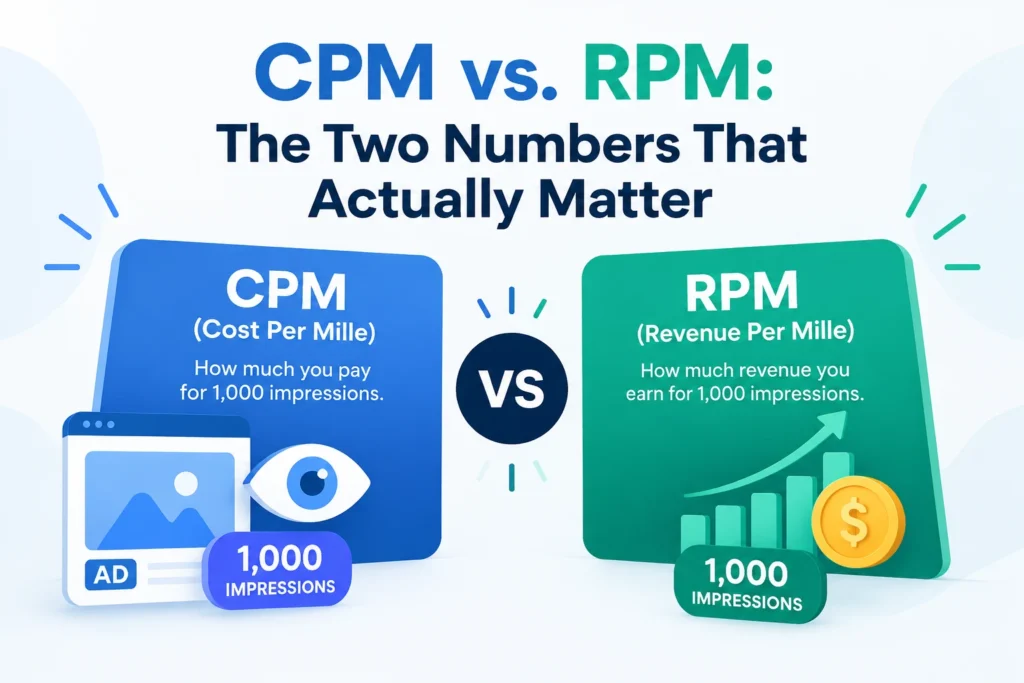
Almost every inflated earnings claim online starts by confusing these two figures.
YouTube CPM stands for Cost Per Mille. It is what advertisers pay for 1,000 ad impressions on your video. That money goes to YouTube first, not to you.
YouTube RPM stands for Revenue Per Mille. It is what reaches your account per 1,000 video views, after every deduction. RPM is your real income number.
The gap between the two comes from four things:
- YouTube keeps roughly 45% of ad revenue on long form videos.
- Not every view triggers an ad, so impressions are always fewer than views.
- Ad blockers, skipped ads, and non monetized regions cut paid impressions further.
- RPM also folds in Premium revenue, memberships, Super Thanks, and Shopping.
A quick example makes the gap obvious. Say your video pulls a $12 CPM on ad impressions. After YouTube’s share and unmonetized views, your RPM often lands near $4.
That is a two thirds drop from the headline number. Any tool or article quoting CPM as creator income overstates earnings by roughly double.
Here is how 100,000 views on a $12 CPM video usually breaks down.
Real Example: How 100k Views Calculate
| Stage | Result |
|---|---|
| Total video views | 100,000 |
| Monetized playbacks (around 65%) | 65,000 |
| Advertiser spend at $12 CPM | $780 |
| YouTube’s share (roughly 45%) | $351 |
| Creator payout | $429 |
| Effective RPM | $4.29 |
The $12 headline became $4.29 in the creator’s pocket. Nothing went wrong in that example. That is simply how the system works on every channel.
Build one habit around this. Open YouTube Analytics, go to the Revenue tab, and read your RPM. CPM belongs to advertisers. RPM belongs to you. Every earnings estimate should start from the second number.
YouTube RPM by Niche in 2026
Niche is the single biggest lever on what you earn. Advertisers bid far more to reach a viewer researching mortgage rates than one watching a highlight reel.
Verified channel data from 2025 and 2026 puts Education and Science at the top, with a median RPM of $10.22. Finance and insurance content commonly sees $12 to $45 CPM, which translates to roughly $9 to $25 RPM. Technology and software runs $8 to $25 CPM. Entertainment and gaming usually sits at $1 to $5 CPM, and often under $2 RPM.
Here is the full YouTube RPM by niche 2026 breakdown.
| Niche | Typical CPM (USD) | Approx. RPM (USD, after YouTube’s cut) |
|---|---|---|
| Finance / Investing / Insurance | $15 to $50 | $8 to $25 |
| Education & Science | $5 to $10 | $2.75 to $5.50 (platform Avg) |
| Technology / Software | $8 to $30 | $4 to $14 |
| Entertainment / Gaming | $1 to $5 | $0.50 to $3 |
| Kids & Teens | Lowest of all niches | Well under $1 |
| Global all niche median | Around $3.50 | Around $2.30 |
Four patterns stand out in this YouTube RPM by niche 2026 data:
- Top paying niches sell expensive products, so advertisers can afford steep bids.
- Kids content earns least because ad personalisation is restricted by child privacy law.
- Mid range niches like fitness, travel, food, and beauty usually land at $2 to $6 RPM.
- Q4 YouTube CPM rates often rise 30% to 50%, then fall sharply in January.
Video length matters too. Videos over eight minutes allow mid roll ads, which lifts RPM meaningfully. Many creators see a 40% to 80% jump simply by moving from six minute uploads to ten minute ones.
Practical Ways to Increase Your RPM
You can lift RPM without changing your whole channel. A few practical moves work across almost every niche:
- Cover higher intent topics, such as buying guides, comparisons, and tool reviews.
- Keep videos above eight minutes when the topic genuinely supports the length.
- Place mid rolls at natural breaks so viewers stay through the ad.
- Publish your strongest commercial videos in October and November.
- Turn on every eligible ad format, including skippable, non skippable, and bumper ads.
Small shifts compound. Moving from a $2 RPM to a $4 RPM doubles income at the same view count.
Shorts and Long Form Pay Very Differently
Shorts changed the math completely. YouTube Shorts pay per view sits far below long form video. Shorts ad revenue is pooled, then split across every eligible creator.
Typical 2026 figures look like this:
- Shorts RPM: $0.01 to $0.07 per 1,000 views
- Long form RPM: $1 to $5 per 1,000 views for most niches
So a Short with one million views may pay $20 to $70 in total. A long form video with 100,000 views in the same niche usually pays more. Creators who treat YouTube Shorts pay per view as a primary income source end up frustrated.
The mechanics explain the gap. Shorts ads run between videos in a feed, not inside your specific clip. YouTube collects that money, pays music licensing costs first, then splits the remainder by view share. Creators receive 45% of what is left over.
Shorts still earn their place. They are the cheapest way to reach new viewers in 2026. Use them for discovery, then move that audience toward long form videos, where the real ad revenue sits. Ending a Short with a clear pointer to a full video works better than a generic subscribe prompt.
What Pakistani Channels Usually Earn

Audience geography moves RPM almost as much as niche does. Advertisers pay far less to reach viewers in Pakistan than in the United States, United Kingdom, or Australia.
How Location Impacts Your YouTube RPM
Realistic figures for YouTube pay per view Pakistan in 2026:
- Local Urdu content for a Pakistani audience: $0.20 to $1.20 RPM
- Mixed audience with 20% to 30% Western viewers: $1 to $3 RPM
- English content targeting US or UK viewers: $3 to $10 RPM
A Pakistani vlog channel with 500,000 monthly views may earn $150 to $400 from ads. The same views from a US finance audience could pay several thousand dollars.
That gap is not a reason to quit. It is a reason to plan differently from day one. Channels here grow income faster through brand deals, affiliate sales, and their own products.
Two adjustments help local creators most. English titles and descriptions open the door to overseas viewers, even on Urdu audio content. Adding English subtitles does the same at almost no cost. Over time, that mix pulls your average RPM upward.
Solid YouTube SEO for Pakistani creators supports the same goal. Ranking for searches made outside Pakistan is the fastest way to raise your effective payout per view.
Common Mistakes When Estimating YouTube Earnings
Five errors cause most of the wildly wrong estimates creators make.
1. Using one generic figure for every channel. Applying a flat $3 to $5 per 1,000 views to any channel can be off by 5 to 10 times. A toy review channel and an insurance channel share nothing. Start from your own niche, then adjust.
2. Reading CPM as take home income. This single mistake roughly doubles most estimates. Advertiser spend is not creator payout. Nearly half of it never reaches you, and neither do unmonetized views.
3. Assuming every view earns money. Ad blockers, skipped ads, and viewers outside monetized regions all cut paid impressions. Real YouTube RPM always sits below what raw view counts suggest. A monetized playback rate of 60% to 70% is normal, not a problem.
4. Relying on outdated payout numbers. The old $18 per 1,000 views claim still circulates in blogs and forum posts. It was never a general rate, and it does not reflect current payouts. Anyone budgeting around it will be badly wrong.
5. Ignoring audience geography. Two identical channels with different viewer countries earn very different money. This matters most for Pakistani creators, where RPM sits well below global averages. Check the Geography tab in Analytics before running any numbers.
6. Forgetting tax withholding on US views. Creators outside the United States face withholding on revenue earned from US viewers. The rate reaches 30% without a completed tax form in AdSense. Pakistan has a tax treaty with the US, which lowers it once your details are submitted correctly. Many creators skip this step and quietly lose income every month.
A simple method beats all the calculators online. Pull your own RPM from the last 90 days in YouTube Analytics. Multiply it by your expected views, divided by 1,000. That gives a grounded picture of YouTube pay per view in 2026 for your specific channel, not an internet average.
Conclusion: Estimating Your Real YouTube Earnings
For most channels worldwide, YouTube pay per view in 2026 falls between $1 and $5 per 1,000 views. Niche shifts that figure more than any other factor. Audience country, video length, format, and season shift it further.
Pakistani creators should plan below the global average. YouTube pay per view Pakistan rates usually land between $0.20 and $1.20 for local audiences. Ad revenue alone rarely sustains a channel at those levels.
The creators who build real income here diversify early:
- Brand sponsorships priced on views and engagement, not on RPM
- Affiliate income from gear and products the audience already buys
- Digital products, courses, or paid communities
- Channel memberships and Super Thanks from loyal viewers
- A steady upload rhythm that compounds watch time month after month
Treat your RPM as a number you review monthly, not once. It moves with your topic mix, your traffic sources, and the advertising calendar. A channel that tracks RPM every month spots problems early. A channel that checks once a year plans on stale figures.
Raising RPM is also a production problem, not only a niche problem. Better retention, cleaner audio, sharper thumbnails, and tighter editing all push watch time up. Higher watch time means more ad slots and better placement.
That is the work our team handles at Delenzo Studio in Lahore. We help creators pick a defensible niche, produce episodes that hold attention, and run their channels consistently. If earning more per view is the goal, this groundwork matters far more than chasing raw view counts.
Start with the growth side in our guide to ranking and growing a YouTube channel in Pakistan. For hands on help, read our YouTube channel management services guide.
YouTube SEO in Pakistan — How to Rank Your Videos and Grow Your Channel in 2026
Learn proven strategies for keyword research, title optimization, Urdu vs English SEO, and algorithm retention tactics tailored for Pakistani creators.
Read Full Guide →Frequently Asked Questions
Most YouTube channels earn $1 to $5 per 1,000 views in 2026. Finance and tech channels reach $8 to $25. Gaming and kids content often stays under $2.
No. The $18 per 1,000 views figure is outdated and was never a general rate. Most channels earn $1 to $5 per 1,000 views today.
CPM is what advertisers pay per 1,000 ad impressions. RPM is what creators actually receive per 1,000 video views, after YouTube keeps roughly 45% of ad revenue.
Finance, investing, and insurance pay most, at $8 to $25 RPM. Technology and software follow at $4 to $14. Gaming and kids content pay the least.
Pakistani channels earn $0.20 to $1.20 RPM on local Urdu content. US and UK audiences pay $3 to $10, often five to fifteen times more.