You finally decided to record a multi-guest video podcast. Great. Now comes the part most people skip entirely: lighting and video setup. And not just any setup. A proper one that works when two, three, or even four people are sitting in the same frame.
Bad lighting is the fastest way to lose viewer trust. If one guest looks washed out and another sits in a shadow, your content loses credibility before you speak a word. Getting the lighting and video setup right is not optional. It is the foundation of every professional-looking video podcast studio setup.
This guide walks you through every layer of a real multi-guest setup. Light types, placement strategies, camera logic, color temperature, and what actually changes as your guest count grows. By the end, you will know exactly what you need and why.
Understanding Light Types — What Every Multi-Guest Podcast Studio Needs
Before placing a single light, you need to understand what each source does. Multi-guest podcast lighting is not a single-source job. Each light has a specific role. Mixing them up leads to flat images, harsh shadows, and uneven exposure across guests.
Key light — the primary source that shapes each guest’s face
The key light podcast is the main light pointed at your subject. It creates dimension and shape on the face. Without it, guests look like they are sitting in a waiting room, not a professional studio. Position it at 45 degrees to the side and slightly above eye level. This single angle adds depth to any face on camera.
Fill light — softening shadows on the non-key side of each subject
Wherever the key light points, a shadow forms on the opposite side. The fill light podcast reduces that shadow without removing it entirely. You want a soft gradient, not a flat, shadowless look. A reflector works well for filling in smaller setups. Dedicated fill panels give more control in larger, multi-guest environments.
Backlight (hair light or rim light) — separating each guest from the background
Without a backlight, subjects merge visually with the backdrop. A rim light or hair light sits behind and above the guest. It creates a thin edge of light on the shoulders and hair. This separation makes each person pop out of the frame. It is especially important in multi-guest setups where crowding is a risk.
Background light — illuminating the backdrop independently from the subjects
The background itself needs its own dedicated light source. Relying on spill from subject lights creates inconsistency. A dedicated background light keeps the backdrop clean, evenly lit, and visually separate from the people in front. It also lets you adjust background brightness independently without touching subject exposure.
Why every additional guest in the frame requires its own dedicated key light
Here is where many setups fall apart. One soft box placed in the centre of the room seems logical. It seems efficient. But it fails every guest sitting beyond a metre from that source. Light falls off quickly with distance. A guest two steps further from the key light will look noticeably darker on camera. Every person needs their own key light positioned for their specific seating angle. This is the core principle of professional podcast studio lighting.
Multi-Guest Lighting — How Setup Changes Per Number of Guests
The number of guests on screen determines every lighting decision. Two guests need a different approach than four. This section breaks it down practically so you know what to prepare before recording day.
Two-person setup — symmetrical key lights on each side, one shared fill, one backlight
A two-person setup is the most manageable configuration. Place one key light on the left for the left-side guest. Place another on the right for the right-side guest. Both lights face inward at 45-degree angles. A single fill light or reflector between them handles the shadow side for both subjects. One shared backlight positioned centrally provides rim separation for both guests. This symmetrical logic works cleanly because neither guest is far from their respective key source.
Three-person setup — three individual key lights, distributed fill, background light
Adding a third person changes everything. Now you have a centre seat sitting exactly halfway between both side key lights. Neither covers the middle guest effectively. The solution is a third key light positioned directly in front and slightly above the centre guest. This is often a ceiling-mounted panel or a top-front softbox on a boom arm. Distributed fill panels on both sides keep the shadow fill even across all three positions. A dedicated background light ensures the backdrop stays consistent behind the middle seat.
Four-person panel — overhead softbox grid or multiple angled key lights with distributed fill
Four guests create a wider scene that a single row of side lights cannot cover. The most practical solution is an overhead softbox lighting podcast grid across the ceiling. Multiple softboxes mounted overhead cover all four positions evenly. Alternatively, two key lights per side, staggered at different angles, can address the full width. Distributed fill panels along the sides balance the shadow sides. A panel setup like this is what professional lighting and video setup looks like in practice. You treat every seat as its own dedicated lighting zone.
Why wide-only lighting fails for multi-guest shows — how uneven exposure looks on camera
A common mistake is placing one large soft source at the front and calling it done. From the camera, the guest closest to the light looks bright and sharp. The guest furthest looks dim, muddy, and underlit. This unevenness is distracting to viewers. It also suggests poor production quality, even if the content is excellent. Wide-only lighting assumes light stays consistent across several metres. It does not. Proper lighting and video setup treats each position individually.
Keeping subjects 5 to 8 feet from the background to prevent unwanted shadow spill
Distance between subject and backdrop matters more than most people realize. When a guest sits too close to the background, backlight and key light spill onto the backdrop. This creates unintended shadows directly behind the guest. Those shadows look like a production error on camera. Keeping guests five to eight feet from the background allows each light source to serve only its intended subject. It also gives the background light room to work without fighting subject lighting.
Color Temperature — The Most Overlooked Factor in Multi-Guest Video Podcasts
Most people focus on brightness. They overlook color temperature podcast lighting entirely. Color temperature is measured in Kelvin. Daylight sits around 5600K. Warm indoor lights sit closer to 3200K. When different light sources in the same frame operate at different Kelvin values, the camera makes every guest look like they were recorded in separate rooms.
Imagine one guest lit by a LED panel at 5600K and another positioned near a window letting in afternoon sun at 4200K. On camera, one guest looks cool and clinical while the other looks warm and orange. Neither looks natural. Neither looks intentional.
The fix is simple but non-negotiable. Every light source in a multi-guest lighting and video setup must be set to the same Kelvin value. For video podcasts, 5600K is the standard. It reads clean on camera and colour grades well in post-production. If you mix sources, use gels to match temperatures before recording begins.
Also consider the room itself. Windows bring uncontrolled daylight that shifts throughout the day. A morning 5600K room becomes a warmer 4000K room by late afternoon. Studios with blackout curtains and fully controlled artificial lighting solve this problem entirely. Every shot looks consistent regardless of what time it is outside.
Lighting and Video Setup at Delenzo Studio — Multi-Guest Podcast Production in Lahore
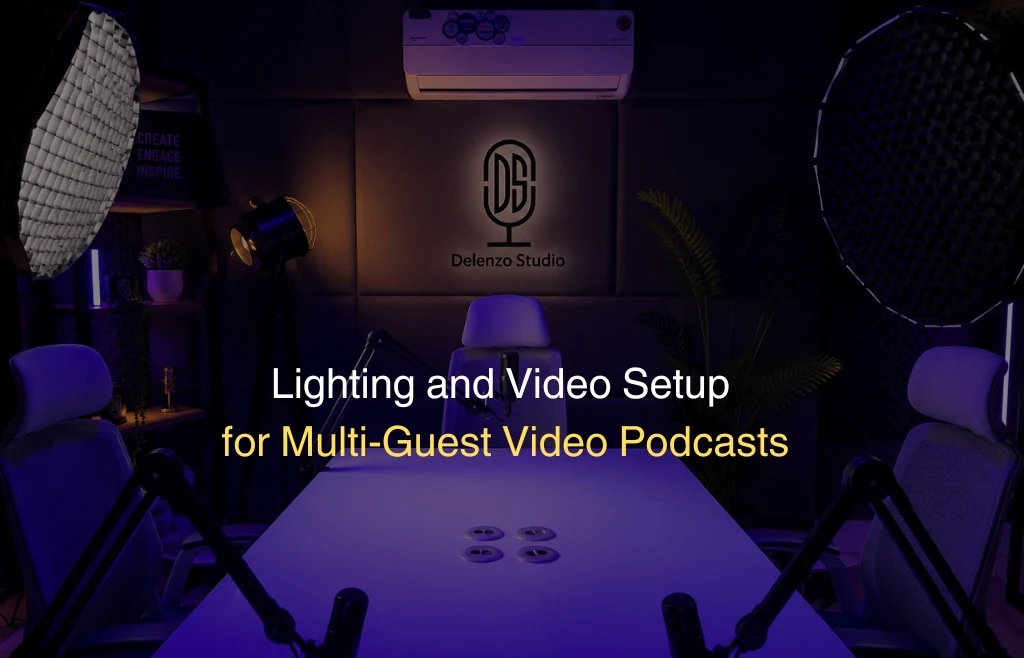
Understanding the theory is one thing. Having access to equipment and space that executes it properly is another. Delenzo Studio in Gulberg, Lahore, is built specifically for multi-guest lighting and video setup at a professional level. Here is exactly what the studio offers.
Camera setup — Sony A7III and Sigma BF for multi-camera multi-guest video podcast recording
The studio runs a multi-camera podcast setup using Sony A7III and Sigma BF cameras paired with Sigma lenses for podcast production. The crew uses multiple camera angles for multi-guest recordings. One wide shot covers the full panel, while individual close-up angles isolate each guest. This setup gives the editor full flexibility during post-production. The crew plans every angle before recording begins, so cutaways feel natural and well-composed.
Lighting — professional LED panels and softboxes with full three-point lighting per guest position
Every guest position at Delenzo Studio receives dedicated three-point lighting treatment for podcasts. The crew uses individual key lights for each seat, distributed fill sources, and rim lights positioned above and behind every guest. The team controls the background lighting independently from the subject lighting. They set and match the color temperature across all sources before recording begins. What you see on the monitor is what the final video delivers.
Backdrop — branded and seamless options available for corporate, creative, and editorial looks
Delenzo Studio offers five backdrop options to match any production style. White works perfectly for clean corporate and product looks. Grey to black adds cinematic depth for interview formats. Brown to grey brings warm conversational tones. Warm neutrals suit lifestyle and creator content. And the chroma key green screen supports fully custom virtual backgrounds. Each option is illuminated independently for consistent, shadow-free results.
Support for two-guest, three-guest and four-guest panel video podcast productions
Delenzo Studio builds every session specifically for multi-guest productions. The team handles two-guest interviews, three-person panel discussions, and four-guest roundtables with full preparation and zero improvisation. The crew pre-plans each configuration before the guests arrive. They adjust lighting positions per seating arrangement and map camera angles before recording begins. This level of preparation is what separates a podcast recording studio Lahore built for professionals from a general-purpose room with borrowed gear.
Location
Delenzo Studio is located at Office 906, Floor 9, High Q Tower, Jail Road, Gulberg V, Lahore. Easy to access from DHA, Model Town, and central Lahore. The podcast studio Lahore team can be reached on WhatsApp at +92 325 1111082 or by email at sales@delenzostudio.com.pk.
Conclusion — Light Every Guest, Frame Every Shot, and Record With Intention
A multi-guest video podcast is a real production. It deserves a real lighting and video setup. Every guest in the frame needs their own key light. Fill sources need to cover the full seating width. Backlights separate subjects from the background. Color temperature has to be consistent across every source. And camera placement must account for every speaking position before you hit record.
These are not advanced concepts reserved for television studios. They are the basics of any production where more than one person sits in front of a camera. Skipping them shows on screen. Following them elevates every frame.
If you are planning a two, three, or four-guest video podcast in Lahore and want a space that handles all of this without guesswork, Delenzo Studio is ready. The studio keeps all equipment in place and fully prepared. The team understands production at every level. And the crew approaches every session with the same level of care, regardless of guest count.
Book your session at Delenzo Studio — Office 906, Floor 9, High Q Tower, Gulberg V, Lahore. WhatsApp: +92 325 1111082 | delenzostudio.com.pk
Frequently Asked Questions
A basic 3 to 4 person setup needs a minimum of 2 to 3 main lights. A professional setup typically requires 4 to 6 lights or more. This ensures every guest is properly illuminated without harsh shadows. More guests mean more dedicated light sources per seating position.
5600K is the standard color temperature for video podcast lighting. It reads clean on camera and edits well in post-production. Set every light source in the studio to the same Kelvin value. Mismatched color temperatures make guests look like they were recorded in separate rooms.
A multi-guest video podcast needs a minimum of two cameras. One wide shot covers the full panel. Individual close-up cameras isolate each guest. Three to four cameras give editors full flexibility. More angles mean smoother cutaways and a more professional final edit.
The 180-degree rule means all cameras must stay on the same side of an imaginary line drawn between guests. Crossing that line flips eyeline directions on screen. This disorients viewers and breaks the natural flow of conversation. Keeping cameras within 180 degrees maintains consistent, watchable screen direction.
Yes. Delenzo Studio in Gulberg, Lahore offers fully equipped sessions for two, three, and four-guest video podcast productions. The studio provides dedicated 4K multi-camera setups, soundproof rooms, professional audio engineering, three-point lighting per guest position, and multiple backdrop options