Your LinkedIn profile is working for you even when you’re not. Recruiters scroll past hundreds of profiles every single day. A blurry selfie or an old group photo cropped down to just your face is not doing you any favors.
The truth is, people form an impression in under a tenth of a second. Before they read your job title, your experience, or your recommendations they see your face. And how that face is lit, framed, and presented tells them a great deal about who you are as a professional.
That’s exactly why professional headshots matter more than most people realise. This guide covers everything you need to know from what makes a great LinkedIn image to how to prepare for your session. And if you’re in Lahore and ready to get it right, Delenzo Studio is built for exactly this kind of work.
What is a professional LinkedIn headshot and why does it matter?
A professional headshot is a photo created to represent you in a business or professional context. Unlike a casual snap or a social media photo, it’s taken with intention controlled lighting, the right background, deliberate framing, and a photographer who knows how to bring out your best expression.
On LinkedIn specifically, your headshot is the very first thing people see. It sits beside every comment you write, every article you publish, and every connection request you send. Studies consistently show that profiles with a quality profile picture receive significantly more profile views and connection requests than those without.The image is not a formality — it’s a signal. of how seriously you take your professional presence.
How it affects first impressions and credibility
Research from Princeton University found that people make judgements about competence, trustworthiness, and likability from a face in as little as 100 milliseconds. On a platform like LinkedIn, where you often don’t get a second chance, that first impression is everything.
A well-executed headshot photo communicates confidence, approachability, and professionalism before a single word is read. It tells the viewer you take your career seriously. Conversely, a poor image too dark, too casual, or poorly framed can undermine even the most impressive professional record.
Think of it this way: if you were meeting a client in person, you’d dress thoughtfully and show up prepared. Your LinkedIn image should reflect that same level of care. Professional headshots are your digital handshake and on LinkedIn, that handshake needs to be firm
Difference between casual photos and professional headshots
People often take casual photos at weddings, on holidays, or in social settings without much thought. Even when the image looks great in that moment, it rarely works well for a professional profile. Uncontrolled lighting, distracting backgrounds, and expressions that feel too relaxed or overly posed often reduce its effectiveness.
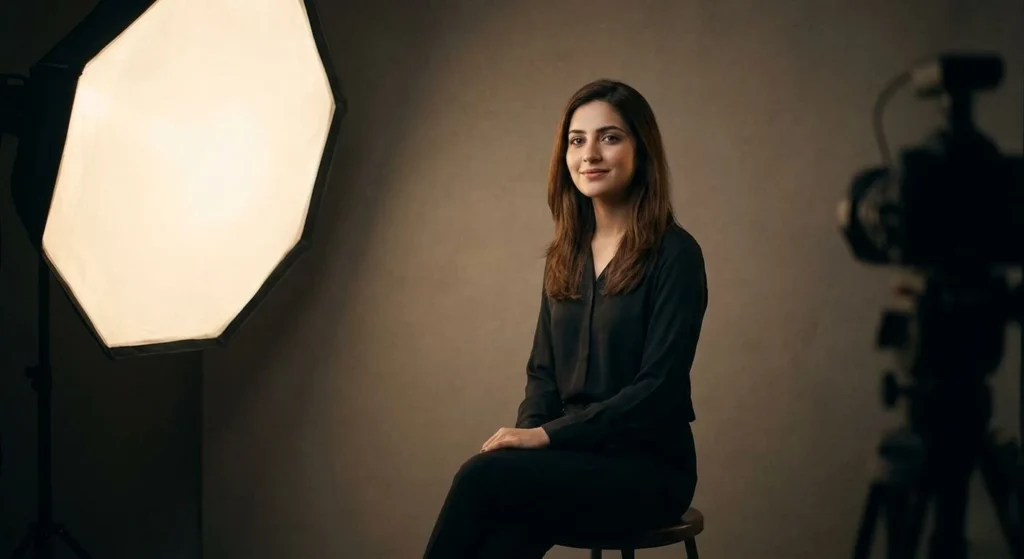
A professional studio headshot works very differently. The photographer carefully shapes and positions the lighting to highlight your features. They select a background that complements your appearance and guide you through subtle adjustments in posture, chin angle, and eye line until the final image looks natural, confident, and polished.
Why book a professional studio in Lahore for your profile picture?
Shooting at home with a phone even a recent flagship model has real limitations. The lens distortion at close range, the inconsistent ambient light, and the lack of a controlled background all work against you. A professional studio removes every one of those variables.
When you book a dedicated studio for your LinkedIn profile picture, you’re not just renting a space. You’re investing in professional headshots delivered with precision lighting equipment and a curated selection of backgrounds. An experienced photographer also guides the session. They have spent years learning how to make people look their best on camera. That combination is very difficult to replicate at home, regardless of how good your phone is.
Access to premium equipment at a studio in Lahore
Professional studio lighting is not something you can approximate with a ring light and a white wall. Studios like Delenzo use high-powered strobes, softboxes, beauty dishes, and reflectors all calibrated to render skin tones accurately and create the kind of depth that makes a face come alive on screen.
Beyond lighting, a studio gives you a professional background for profile picture shooting whether that’s a seamless paper backdrop in a flattering neutral tone, a textured wall, or a carefully composed environmental setting. Each choice supports a different look and level of formality.
At Delenzo Studio in Lahore, all equipment is meticulously maintained to a professional commercial standard. Furthermore, every session is captured using high-resolution, full-frame cameras paired with premium professional glass. As a result, the difference in image quality between a controlled studio session and a DIY photo is not just subtle; it is immediately apparent to anyone viewing your profile. Ultimately, this superior technical finish ensures your first impression is one of absolute credibility and authority.
How to create the perfect LinkedIn profile picture
Getting a great LinkedIn image is part preparation, part technique, and part knowing what actually works on the platform. Here are the key elements that make the difference between an average shot and one that genuinely elevates your profile.
Framing and the 60% face rule
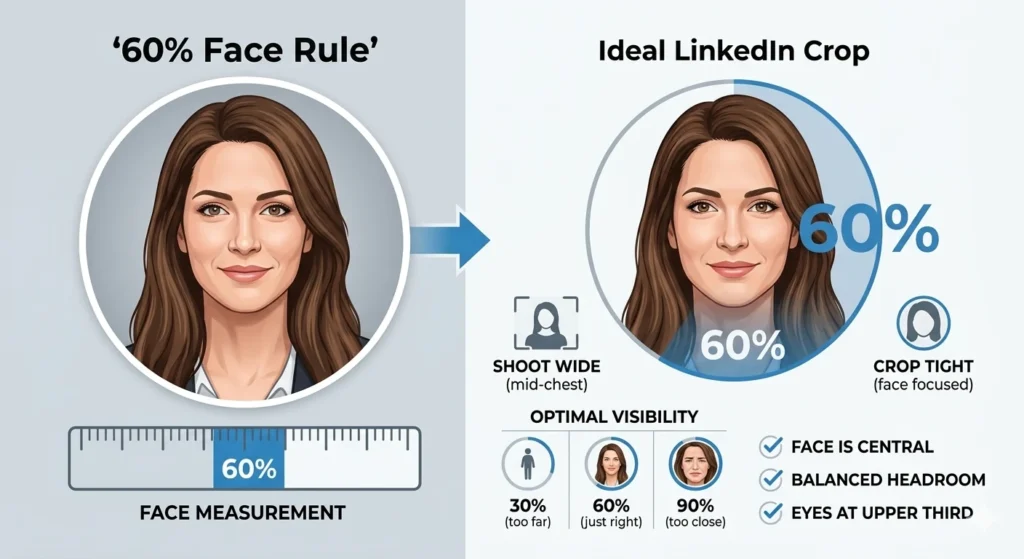
LinkedIn displays profile photos in a small circular frame, so most of what viewers see is the face. Because of this, framing becomes extremely important. The professional standard is to fill roughly 60% of the frame with your face, ensuring your features remain clear even when the image appears small on screens.
Typically, photographers shoot headshots from mid-chest upward, placing the face centered or slightly off-center while positioning the eyes near the upper third of the frame. However, too much empty space above the head can make the image feel unbalanced, while cropping too tightly can feel intense or cramped. Therefore, a balanced composition helps the photo appear natural, confident, and professional on LinkedIn.
A good professional headshot photographer will dial this in for you automatically. They know how the image will look at thumbnail size on a feed, at full size on a profile page, and in a search result. Getting the framing right from the start saves time in editing and ensures the image works across every platform it’s used on.
Lighting and contrast tips
Lighting is the single biggest factor that separates a good professional headshots session from a great one. Here’s what to keep in mind.
- Soft, directional light — Use a large softbox or umbrella positioned at 30–45 degrees to the side of your face. It creates flattering shadows without harshness.
- Avoid direct flash — On-camera flash flattens facial features and washes out skin tone. Always diffuse your light source.
- Fill the shadows — A reflector on the opposite side of your key light softens the shadow side of the face. This keeps the image looking natural and approachable.
- Watch the background contrast — Your face should be the brightest, sharpest element in the frame. A slightly darker background helps the subject stand out immediately.
- Check catch lights — The small reflection of the light in the eyes gives a headshot energy and life. Without it, eyes can look flat and lifeless.
- Match light to skin tone — Lighter skin tones need softer, lower-power light. Darker skin tones benefit from a stronger key light and a silver or gold reflector for fill.
Backgrounds: neutral vs blurred office settings
The background in your headshot does more work than most people expect. It sets the tone, supports the subject, and communicates something about your professional context even when it’s just a plain grey wall.Neutral backgrounds white, light grey, or warm charcoal are the safest and most versatile choice. They work for every industry, every platform, and every professional context. They keep attention on your face and don’t date as quickly as trend-driven backgrounds.
Blurred office or environmental backgrounds can add authenticity and context particularly for creative professionals, entrepreneurs, or anyone whose brand is tied to a specific environment. A softly blurred bookshelf, a workspace, or an architectural detail can all add character without distraction. The key is control. In a studio, you decide what goes behind you. That choice is intentional, not accidental. A strong headshot image always pairs the right background with the right subject and in a professional studio, you have the full range of options to choose from.
Outfit guidance for corporate and creative professionals
What you wear in your headshot should reflect how you show up professionally but it also needs to work photographically. Those two things don’t always automatically align. For corporate headshots, the standard is straightforward: a well-fitted suit, blazer, or formal top in a solid, muted colour. Navy, charcoal, white, and grey all photograph cleanly. Avoid loud patterns, large logos, and highly reflective fabrics that can create distracting glare under studio lights.
Creative professionals have more latitude and often, a more relaxed or expressive outfit better represents their brand. That said, the same principles apply: fit matters more than brand, and solid colours read more clearly than busy patterns at small sizes. Bring two or three outfit options to your session if you can. Having choices gives you and your photographer more flexibility to find the combination that works best for both your industry and the background you’ve selected.
Professional headshots vs AI-generated images
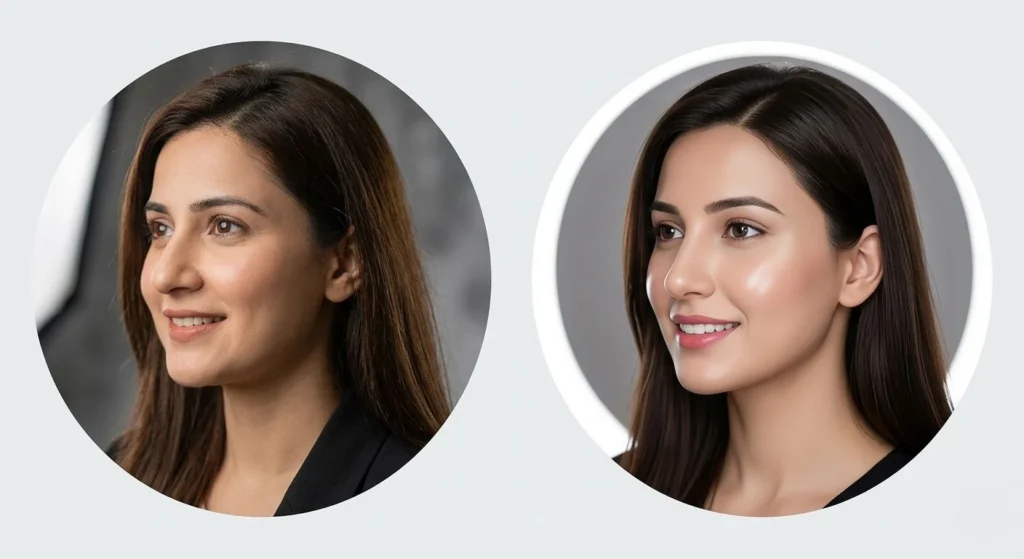
AI headshot tools have become increasingly popular over the past couple of years. Upload a few selfies, pay a small fee, and receive a polished-looking profile photo within minutes. It sounds convenient and for some low-stakes uses, it can be. But there are real, meaningful differences between what an AI tool produces and what a trained photographer captures in a studio. When it comes to professional headshots for LinkedIn or career-critical profiles, those differences matter far more than most people expect.
AI tools are trained on image data. They’re good at producing something that looks superficially like a headshot pic. But they struggle with authenticity, the genuine expression, the natural skin texture, the quiet confidence that only comes from a real human interaction between subject and photographer. Recruiters and hiring managers often spot AI-generated images immediately, and the association is rarely positive.
In-Studio vs AI Headshots: A Direct Comparison
| Factor | In-Studio Headshot | AI-Generated Image |
| Authenticity | Real expressions and natural personality captured by a photographer | Can appear artificial or unrealistic |
| Image Quality | High-resolution with accurate colours and lighting | Often lacks detail and natural skin tones |
| Guidance | Photographer helps with poses and expressions | No guidance; results depend on input |
| Delivery Time | Usually delivered same or next day after editing | Generated instantly but may need editing |
| Best For | LinkedIn, corporate profiles, résumés, personal branding | Temporary or internal use |
How to prepare for your session at Delenzo Studio
A great headshot is a collaboration. What you bring to the session matters just as much as the equipment and expertise on the other side of the lens. The good news is that preparing well for your professional headshots takes very little time and makes a significant difference in the final result. Here’s what we recommend for every client before their session at Delenzo Studio. These steps are simple, practical, and based on real experience of what actually makes sessions go smoothly.
Posing tips
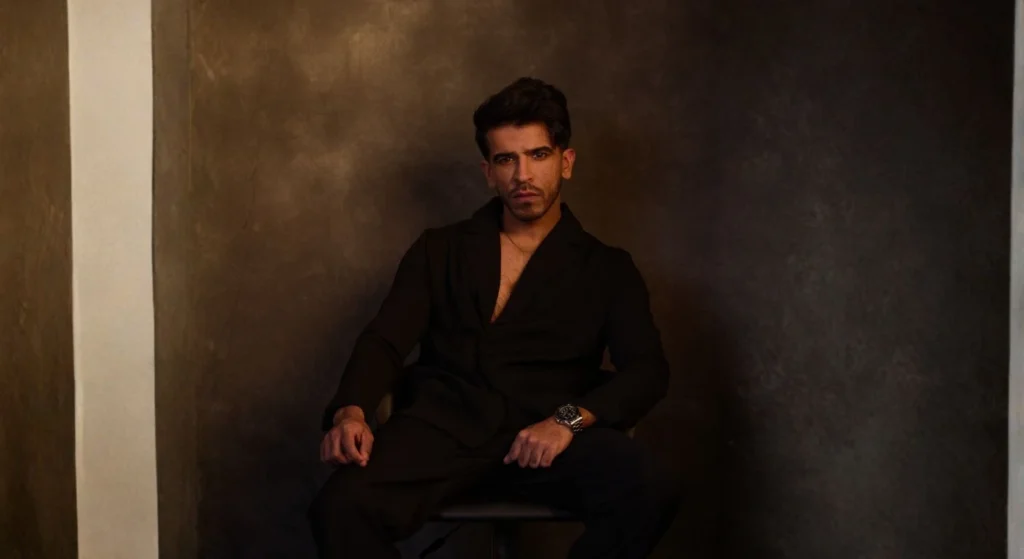
You don’t need to know how to pose, that’s the photographer’s job. But a few basics go a long way.
- Sit or stand slightly angled — A straight-on stance can look stiff. A slight turn of the shoulders toward the light looks more natural and dynamic.
- Push your forehead very slightly forward — This reduces the appearance of a double chin and creates a more defined jawline. It feels odd but looks great on camera.
- Relax your jaw — Tension in the jaw reads on camera. Take a deep breath, drop your shoulders, and let your face settle before each shot.
- Find your stronger side — Most people have a side they photograph better from. Your photographer will identify this quickly and work from it.
- Smile with your eyes — A genuine, relaxed smile starts in the eyes. Think of something that actually makes you happy rather than just saying “cheese”.
Hair and makeup support
For professional headshots, the goal is enhancement, not transformation. You want to look like the best version of yourself. Studio lights are revealing. They pick up shine, uneven skin tone, and flyaway hairs. A light layer of matte powder helps. If you wear makeup regularly, go slightly heavier than usual, studio lights naturally wash out colour. Hair should be freshly washed and styled as you would for an important meeting. At Delenzo Studio, we advise on styling as part of every session. A full makeup artist can also be arranged.
Cross-Service Opportunity: Combine Your Headshot with a Podcast or YouTube Session
If you’re already coming into the studio, it makes a lot of sense to maximize your time and the professional setup. In fact, many of our clients at Delenzo Studio now strategically combine their LinkedIn headshot session with a short podcast recording or YouTube content shoot on the same day. Since the studio is already perfectly lit and the cameras are fully calibrated, it is the most efficient way to produce content. Moreover, because you are already professionally groomed and dressed, adding a 30-minute content session means you leave with both a premium profile picture and a library of video assets. Ultimately, this allows you to build a consistent brand presence across all platforms in a single, controlled environment.
This is particularly valuable for founders, coaches, consultants, and anyone building a personal brand across multiple platforms. A single studio visit can produce your LinkedIn image, your YouTube thumbnail, your website bio photo, and your podcast cover art all consistent, all professional, all done in one go. Talk to us when you book and we’ll put together a session plan that covers everything you need. Delenzo Studio is set up to be your complete personal branding studio in Lahore not just a place to get a single professional headshots taken.
Frequently Asked Questions
Professional LinkedIn headshots in Lahore typically cost PKR 2,500 to PKR 5,000, depending on the studio, session length, and number of edited images. At Delenzo Studio, packages include professional editing, ensuring your headshot is ready for LinkedIn and other professional profiles while helping you make a strong first impression with recruiters and clients.
Update your LinkedIn profile picture every two to three years or sooner if your appearance changes significantly, such as a new hairstyle, weight change, or major career shift. Your photo should accurately reflect how you look today. An outdated image damages trust, especially when meeting connections in person for the first time.
Yes a natural, relaxed smile is almost always the right choice for a professional headshot. It communicates warmth, approachability, and confidence. Avoid a forced or overly wide smile; instead aim for the expression you’d use when greeting a respected colleague. Your eyes should reflect the smile, not just your mouth.
LinkedIn recommends uploading your profile photo as a JPG or PNG file. The ideal size is at least 400 x 400 pixels, with a maximum of 8MB. Use a high-resolution file to prevent compression artefacts. PNG preserves quality better for images with solid backgrounds, while JPG works well for most standard headshot photographs.
A phone can produce a passable headshot photo in ideal conditions but real limitations remain. Lens distortion, inconsistent lighting, and background noise are hard to control. For a LinkedIn image that competes professionally, a studio session delivers better results: accurate skin tones, controlled light, and expert direction no phone can replicate.
A professional headshot is tightly framed, typically from the chest up with a clean background and a clear professional purpose. In contrast, a portrait is broader in scope, as it can include environmental context, full-body framing, or a more artistic intent. Specifically, headshots are built for LinkedIn, CVs, and brand profiles, whereas portraits tell a wider visual story.
A standard headshots session at Delenzo Studio takes 45 to 90 minutes, covering setup, outfit changes, and multiple lighting setups. Most clients leave with 3 to 5 polished images. You can also combine your session with a podcast or YouTube shoot all in one visit.